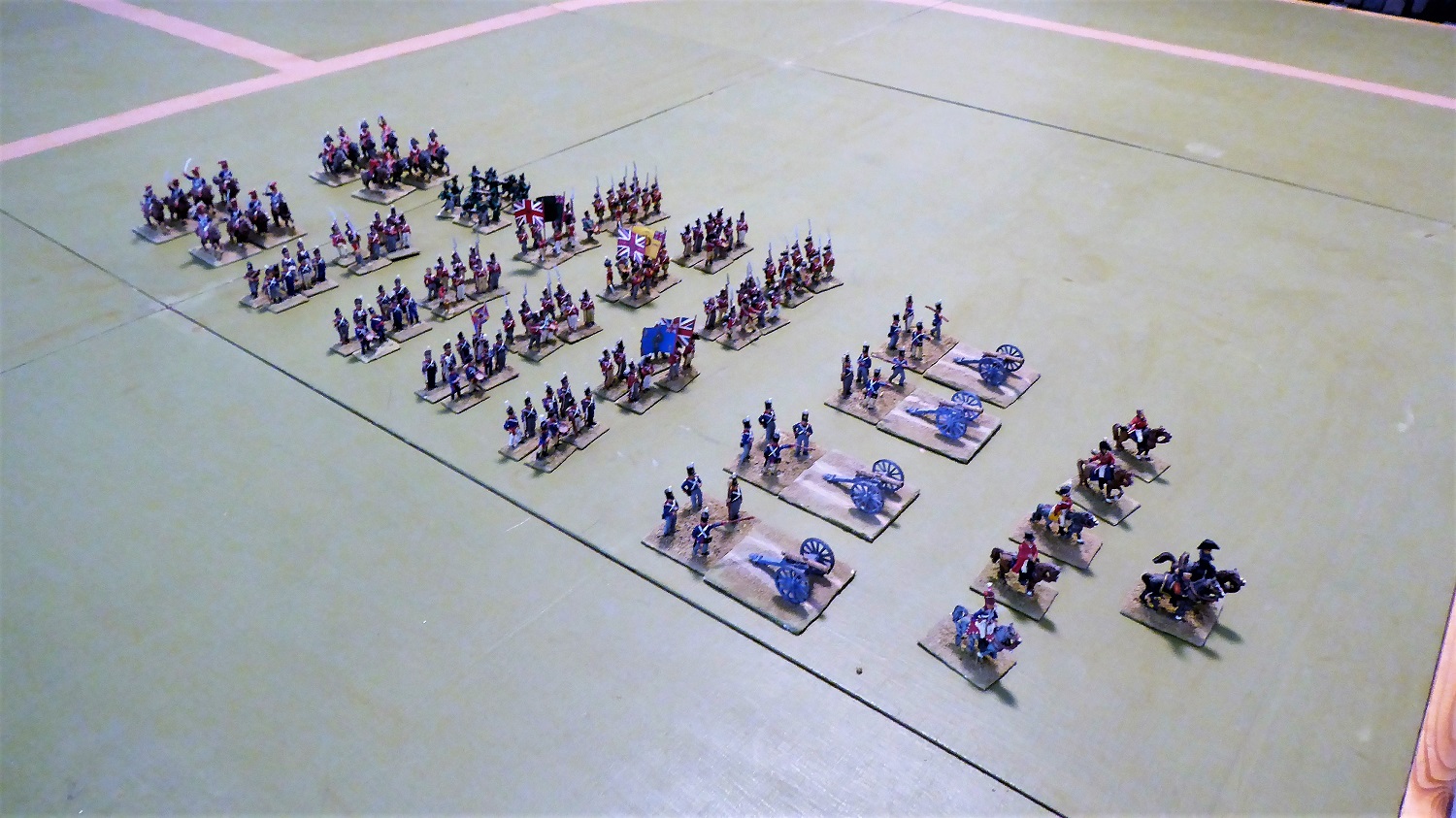
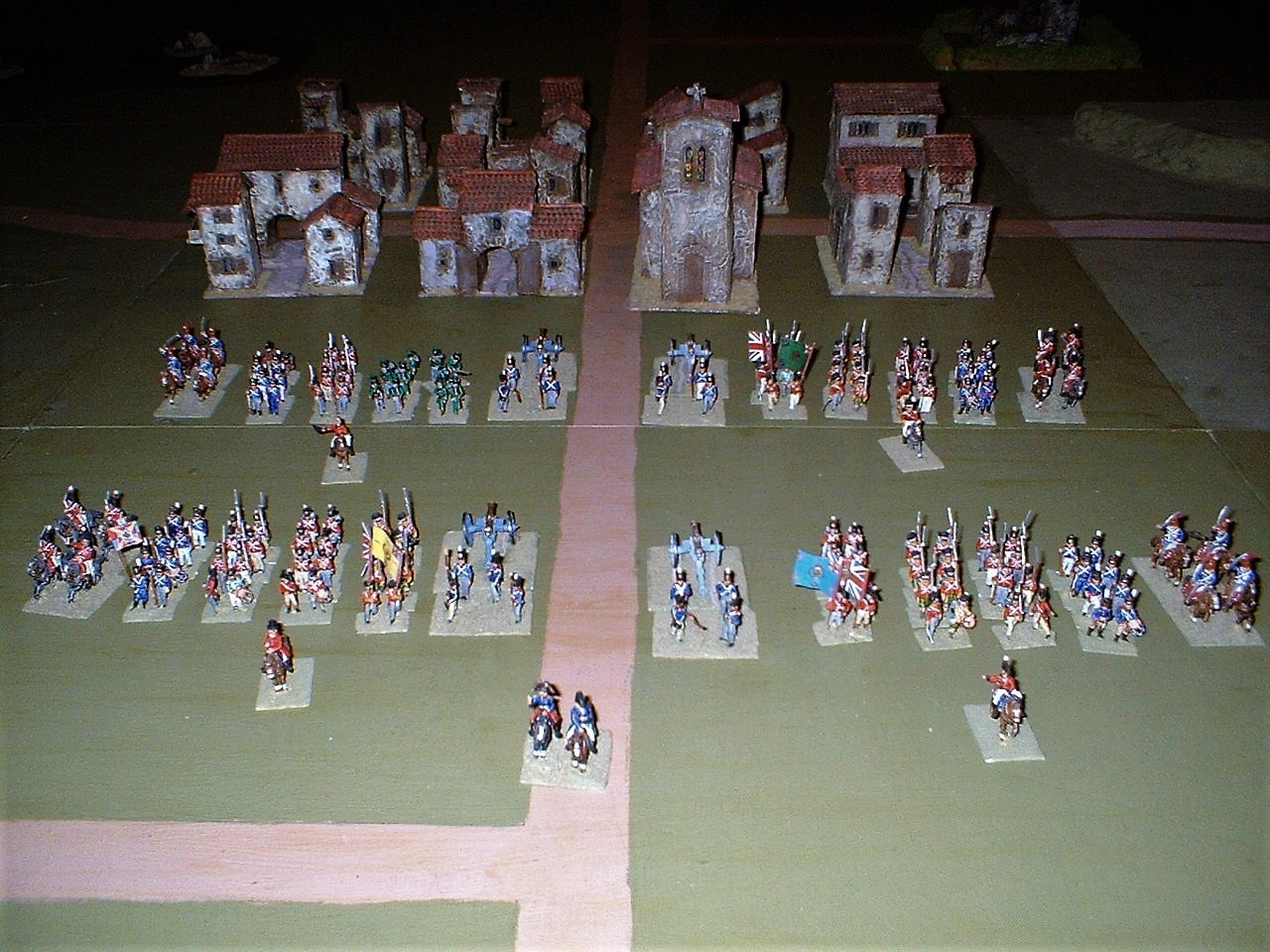
21 April 1813 –
Southern Spain – Day 1
Both armies have deployed their corps close to the border
This presents resupply problems for both the French and the
Spanish
Both sides are too far from their rear depots to resupply
So both armies have to transfer supplies to the forward
depots
This is more of a problem for the Spanish, who can only hold
three days
The French can hold four days.
The campaign opens with 14th French army
attacking Daimiel.
Battle of Daimiel
end of move 6
Daimiel is defended by 1st Spanish army, the best
of the three armies
The Spanish fight a very defensive battle, and give a good
account of themselves
They hold their own in one of the two cavalry melee
They also rout one Italian infantry brigade in melee
But they quickly crumble as casualties are received
By midday the battle is still undecided
The Spanish have lost the northern flank
They still hold the town
They are holding their own on the southern flank
However Giron loses his nerve and orders a general retreat
The French have lose 500 casualties, the Spanish 1300
Comments
The town of Daimiel is on the main road between Albacete
and Cuidad Real
For this reason it is held by the best of the three
Spanish armies.
There is very little in combat and morale between the
French and the Spanish
27th French corps is slightly better than 1st
Spanish corps
28th Italian corps is no better than 2nd
Spanish corps
The Spanish gunners are B class, as are the French
gunners
But the Italian gunners are C class.
Because of the more able Spanish gunners the French
commander had to launch an early attack, rather than wait for his gunners to
soften up the Spanish infantry.
The only advantage that the French had was that they
could choose who would attack where.
The formation of a small reserve of two infantry brigades gave them a
slight advantage when they were committed to one flank or the other. A frontal attack was out of the question
because Daimiel was strongly held.
The Spanish were deployed either side of the town, but
not in front of it. This allowed the
French artillery to deploy within short range of the town. This in turn forced
the Spanish to advance to support the town garrison.
The battle was decided by hand to hand fighting. This was a risky choice, because the French
and Spanish infantry and cavalry were quite evenly matched. It was made worse because the main attack
was given to the Italian corps. This was
because of the terrain, which favoured them rather than the French corps.
The opening artillery fire was pretty ineffective.
This was followed by a two cavalry melee, one on either
flank. In the north the French gunners
did inflict 10% casualties on the Spanish dragoons. This would make it easier for the French to
win this melee. Having done so they
failed to rally, and pursued the routed Spanish cavalry, causing even more
casualties
In the south the Spanish cavalry were C class, against
Italian B class. Despite this the
Spanish performed well, and the first round of melee was a draw with both sides
suffering 10% casualties. Giron orders
the Spanish army to retreat before a second round could be fought.
But most interesting was the infantry melee on the
southern flank. There were two brigades
on each side. One was B class and the
second C class. But by chance one B
class opposed one C class in both melee.
The result was that the Spanish routed one Italian brigade, and had one
of their own routed in turn.
Given that the battle was undecided it might seem strange
that the Spanish commander ordered a retreat just half way through the
day. However the two reserves would make
the difference. The Spanish reserve was
in the town, and unable to support either flank. The French reserve was in the centre.
With the loss of the Spanish left flank, the French
commander committed his reserve to support the Italian attack on the right
flank. The Spanish retreated before the
reserve could arrive, but had they not done so they would almost certainly have
suffered heavy casualties. So the
Spanish decision to retreat was, in my opinion, the right one.
An interesting wargame, and the right result for the
opening battle of the campaign. Had the
French lost this battle the prospects for the rest of the campaign would have
been bleak.