Showing posts with label 51 - 1813 Campaign - Armies. Show all posts

Sunday, 4 October 2026

Planning the armies of the 1813 campaign


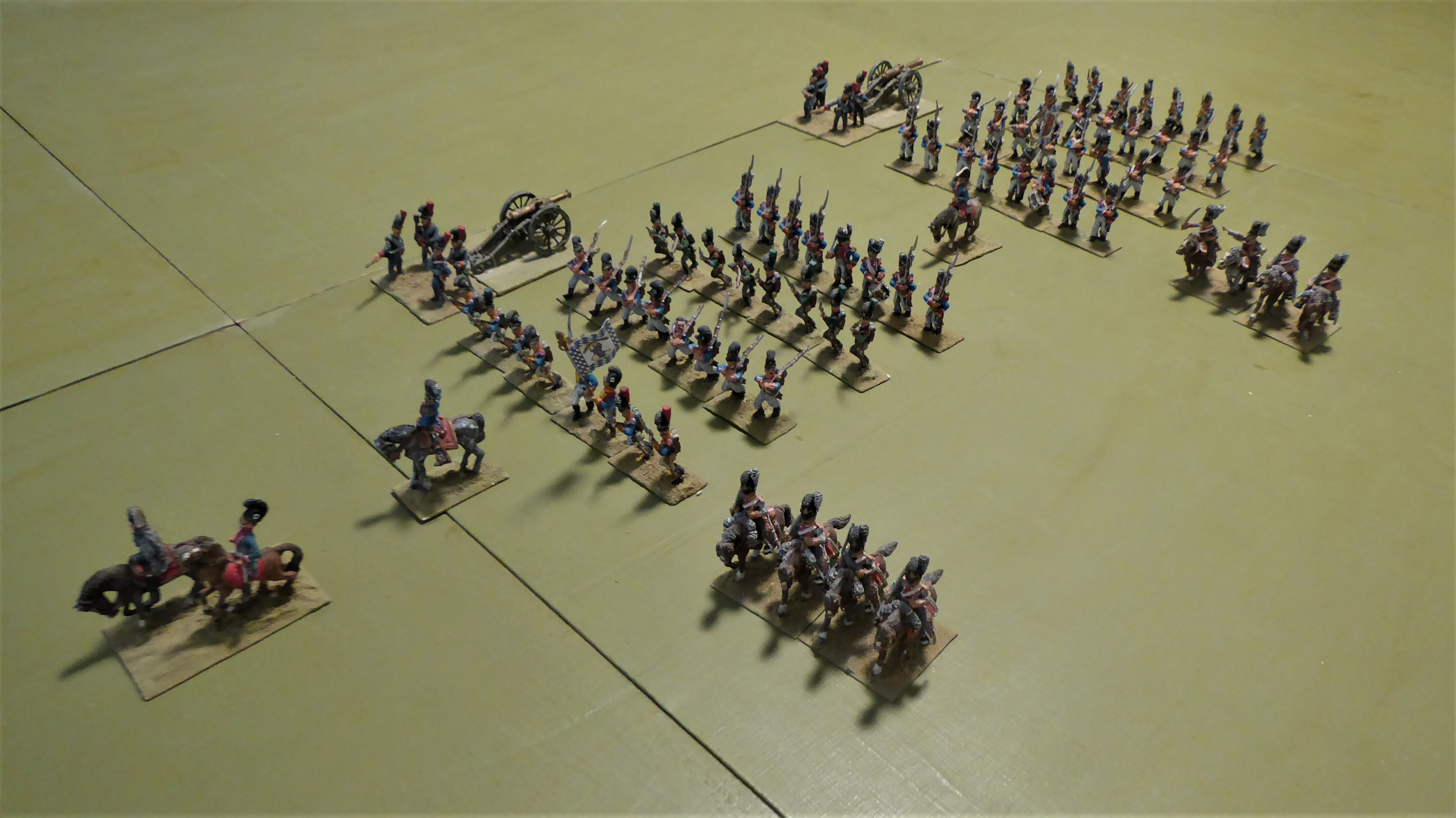
Typical corps


I explained last week how I found myself with a large collection of painted figures, from which I now wanted to create all of the major armies of the 1813 campaign.

I had a very clear idea what I wanted to achieve, but not how to do so.

I wanted to use every figure in my collection in a series of campaigns

So do so I wanted to use them in sequence, with one allied nation in each campaign

I had 160 infantry, 16 cavalry and 4 guns in each allied “army”.    This was to be a fictional campaign based on 1813.  But I wanted to make it “feel” and look like a Napoleonic campaign.   So the basic army had to be a corps.  It would be very unusual for a French army to have just one corps, so my existing figures would have to represent three or four corps.  My wargames table was built by using nine 2x2 foot squares.

They were three wide and three deep.   I found that if I divided each army into four corps they would fit one corps to one square.    Thus I could have three corps wide and one corps in reserve for each army.

Fortunately my armies provided 4 infantry, 1 cavalry and 1 gun for each of the new four corps.   You will see what I mean in the photograph above.   Each corps would have 4 brigades of 8 infantry, one brigade of 4 cavalry and one corps artillery of one gun.   The four infantry figures left over would provide skirmishers if required.

I based the infantry and cavalry two figures to a stand.    This means that my infantry brigades could form column of march, column of attack, line and square.    My cavalry could form column of march and line.   I had to get used to 8 figures representing a brigade of infantry, but that was an acceptable compromise.  

Before leaving the UK I had discovered Le Feu Sacre (LFS) rules, which I really liked using.  However they are designed for a one corps game, with 12  infantry figures representing a battalion.  I decided to design my own rules, relying very heavily on the principles of LFS.   The only difference was that I replaced their orders of battle with my own 8 infantry figure brigades, 4 cavalry figure brigades and 1 gun for corps artillery.

These rules rely on command and control very heavily, which I liked.  It rewarded historical Napoleonic tactics.   Their command figure was brigade and division.   Mine would be corps and army.

I am very pleasantly surprised to find that the original planning back in 2008 has largely survived 18 years of frequent Wargaming.   We always have a game on the table and have a couple of moves four or five times a week.  It usually takes us about 10 to 14 days to complete a 12 move game.

The only major adjustment is that we soon adapted to three corps games.   This meant that each mini campaign order of battle would consist of slightly different armies as I switched the four corps to provide armies of three corps.

Next week I will consider designing the wargames table, which would be the foundation of the orders of battle and the campaign maps.

Sunday, 11 May 2025

Infantry Combat and Morale Values - The Solution


Typical Austrian Corps

All corps of all nationalities, except for the French Old Guard and the Spanish Army, will have the same combat and morale value as follows:

1 infantry brigade CA FB SC
2 infantry brigade CB FC SA
3 infantry brigade CB FB SB
4 infantry brigade CC FC SC
1 cavalry brigade CB
1 artillery brigade CB

C indicates the class of troops, used for morale
F indicates firepower, used for volley fire
S indicated skirmish ability

A are elite and will add plus 1 for combat or morale
B are trained
C are conscript and will be minus 1

In addition each casualty will deduce 1 for both combat and morale tests

In the past the same grades were used, but each brigade had a different combination of plus or minus for morale, volley fire or skirmish. This made it difficult to compare and identify different abilities on the wargame table. The order of battle sheet had to be consulted each time there was a combat or morale test.

In future the first brigade will be elite, and where possible grenadier figures will be used
They will be ideal for hand to hand fighting, average for volley fire and poor for skirmishing

The second brigade will be excellent skirmishers and jager, riflemen or light infantry figures used
They will be most suited for open order fighting, average for morale and poor for volley fire

The third brigade will be standard, trained infantry, line infantry figures used to represent them
They will be average for morale, volley fire and skirmish

The fourth brigade will be poor quality and landwehr or militia figures used when possible
They will be poor for morale, volley fire and skirmish.

This will make it very easy to allocate the most suitable brigade to each task, and also make it easier to identify them on the table.


French Old Guard

This is the only exception, apart from Spanish infantry. They are the elite of the French army, but by 1813 were not on a par with the Imperial Garde before the Russian campaign. I wanted them to be different from the other corps, but I may change my mind about that after play testing.

1 infantry brigade CA FB SC
2 infantry brigade CB FB SB
3 infantry brigade CB FC SA
4 infantry brigade CC FC FC
1 cavalry brigade CB
1 artillery brigade CB

The first two brigades are grenadiers, the last two chasseurs. So the elite skirmishers are in the third brigade. The fourth brigade are conscripts.

Typical Spanish corps

I have sufficient figures for four Spanish corps, but only enough cavalry for two corps. This was deliberate, because I wanted the Spanish to be weak in cavalry.

1 infantry brigade CB FC SC
2 infantry brigade CC FC SC
3 infantry brigade CB FC SB
4 infantry brigade CC FC SC
1 cavalry brigade CB 
1 artillery brigade CB 

At present I am using a completely different order of battle for the Spanish. This is because even in 1813 they were inferior to the French infantry, even to the conscripts. This will be very hard to replicate on the wargames table.

In addition only half of the Spanish corps have cavalry, which leaves them at a huge disadvantage.
To counter this I have increased their armies to four corps, rather than the three in all other armies.
They will also have the advantage of large bodies of guerrilla brigades to attack French lines of supply.

Once more I may change my mind about this after a period of play testing.  

Sunday, 4 April 2021

New Order of Battle

The new 6 corps armies have worked so well in the Valladolid campaign that I have decided to replace the previous 4 corps permanently.   Consequently I have rewritten the orders of battle for all ten armies, and photographed the new 6 corps armies.

Each of the previous ten armies are now army groups, though this is not a recognised Napoleonic formation.   So instead they will be called “French Army of North Germany” for example.  

Each army group will consist of three armies, each of two corps.   The next campaign phase will be set in southern Germany.   The two army groups are:


7th Bavarian Army.

9th Bavarian corps

10th Bavarian corps


8th Bavarian Army

11th Bavarian corps

12th Baden corps


9th French Army

17th French corps

18th French corps


1st Austrian Army

1st Austrian corps

2nd Austrian corps


2nd Austrian Army

3rd Austrian corps

4th Austrian corps


3rd Austrian Army

5th Austrian corps

6th Austrian corps

If you would like more information you will find the full order of battle, plus photographs, of all ten armies on the Campaign Diary Blog here http://1813pbemcampaigndiary.blogspot.com.es/

Sunday, 13 December 2020

Six corps armies


Campaign map with six corps per side


You will recall that the problem was to increase the size of campaign wargame armies from four to six corps per army.   This would result in more figures on the table, even for the smaller campaign games.


It would be easy for the French armies.   There are 13 corps available, so dividing them into 6 corps armies would not be a problem.


However for the Austrian, British, Prussian, Russian and Spanish armies there were only 4 corps available for each nationality.


I could have combined allied armies into a combination of two allied nations, for example Austrian and Russian, to produce a six corps army.   But this would cause problems with the permanent orders of battle proforma we used in our wargames.   It was not a huge problem, but it was a messy one.


My “light bulb idea” came after a few weeks of considering other options.   I would use left, right and centre columns for campaign movement.    Each column would have two corps.   The left and right columns would use the same figures, but different corps numbers.   The centre column would use the other two corps.


I hope that the map above will make this more clear.  


Four corps French Army


In the French army 1, 2, 3 and 4 corps are the original, and each are different figures

5 and 6 corps are new.   They are duplicates of 1 and 2 corps, and use the same figures.   The campaign will open with the three columns advancing to engage the enemy.   As the campaign progresses it is quite possible that the two centre corps may combine with either the two northern, or the two southern columns.   But it is very unlikely that the northern and southern columns will ever fight together.   This means that it will be possible to wargame any battle consisting of 1,2,3 and 4 corps.    Or 3,4,5 and 6 corps.


In theory this seems to work well, and will allow me to wargame with more figures in all campaign games.   But I will need to try it out for a couple of campaigns to see if there are any unforeseen problems.

Sunday, 6 December 2020

Getting more figures on the table


Campaign map with four corps per side


When I designed the campaign I wanted to be able to use all of our figures and scenery more or less in sequence.   I also wanted to play multi corps games.   And I wanted to achieve all of this without buying and painting new figures.


I had a reasonable collection of 28mm Napoleonic figures.   They were painted in 32 figure infantry units, 8 figure cavalry units and 1 gun with four crew.   Each allied nation has armies of 128 infantry, 16 cavalry and 4 guns and crew.   The French had many more in the same proportion.

Four French corps

This was converted into corps of 32 infantry, 4 cavalry and 1 gun with 4 crew.

There were four such corps for each allied army and 13 French corps.


Each army would have four such corps, giving 128 infantry, 16 cavalry and 4 guns with 16 gunners


My wargames table is 6x6 foot, using 2x2 foot scenic boards.   One corps could comfortably fit on each scenic board.   So a whole army could deploy on the table with three corps in line and one in reserve (see map above)


The aim was that campaigns would start with a series of one corps per side battles, they would then concentrate for two corps per side and the campaign would be decided by a final battle of three or four corps per side.  In theory this seemed like an ideal selection of wargames of different sizes.


However in fact most campaigns are decided by five or six battles.    The first three are usually one corps per side, then two or three.   I don’t think we have ever fought a campaign game with the full four corps per side.


This was largely because of the way the campaign took on a life of its own.   When a corps is defeated they have to retreat directly away from the winner.   By the fourth battle corps would often be spread all over the place.    Having to halt to resupply at least every four moves also added to the difficulty of concentration.   And, of course, the winner would not usually allow the loser the luxury of recovering and redeploying as and where he pleased.


The result was a lot of smaller battles.   They can be interesting, but they are limited and usually do not last for very long.  In a word, they can be a little boring.

Four Prussian corps

For many years I have struggled to make the battles larger.   It can be done by moving each corps on the map to result in larger battles.  But to do so I would have to ignore the resupply and combat rules, and that would destroy the ability of the map campaign to “have a life of its own”


So for the past few months I have been pondering how to increase the size of each army from four corps to six corps.   But to do so within the confines of the groups of model soldiers already available.


Sunday, 16 June 2019

Organisation of French Imperial Garde


1st Old Guard Corps

This is the orbat of the Old Guard, which is one of four corps in the French First Army

1st Old Guard corps - General Friant (Average)
1 infantry brigade     4000   CA      FB      SB
2 infantry brigade     4000   CB      FB      SB
3 infantry brigade     4000   CB      FC      SB
4 infantry brigade     4000   CB      FC      SB
1 cavalry brigade     1000   CA      light
1 corps artillery        1000   CB      12 pounders

There are four infantry brigades, two grenadier and two chasseur.  
I do not use the division level of command in my campaign
However this is in fact a grenadier division and a chasseur division

2nd Young Guard Corps


This is the orbat of the Young Guard, which is one of four corps in the French Second Army

2nd Young Guard corps - General Compans (Average)
5 infantry brigade     4000   CB      FB      SB
6 infantry brigade     4000   CB      FB      SB
7 infantry brigade     4000   CB      FC      SB
8 infantry brigade     4000   CB      FC      SC
2 cavalry brigade     1000   CA      heavy
2 corps artillery        1000   CB      12 pounders

Again there are four infantry brigades, two voltiguer and two fusilier
These are in fact a voltiguer division and a fusilier division

Combat and Morale
The last three columns indicate their morale and combat effectiveness
A is best, B is average and C is poor

C stands for class in the left hand column
A gets plus one on all morale dice throws
B neither adds nor deducts from morale throws
C deducts one on all morale dice throws

F stands for volley fire power in the centre column
A adds one to each fire dice throw
B neither adds nor deducts for firing throws
C deducts one for each fire dice throw

S stands for skirmish in the right hand column
A adds 3 to each skirmish dice throw
B adds 2 to each skirmish dice throw
C adds 1 to each skirmish dice throw

Strength of Guard Corps
The cavalry are particularly good, with both brigades classed A
The artillery is also good, with both corps equipped with 12 pounder guns
Only the senior infantry brigade is classed A (elite), the remainder are B (average)
Half of the infantry have B (average) volley fire, the remainder are C (poor)
Only one infantry brigade are C (poor) skirmish, the remainder are B (average)

Both guard corps have more average skirmish brigades than other French corps
Only one out of eight brigades are classed as C skirmishers
In most French corps two out of eight brigades would be C class skirmishers
This is because in our rules dice play a large part
If one side is unable to hold the skirmish line they suffer heavy casualties
In historical battles the guard would have been in reserve and not open to skirmish

In general these two corps are slightly better quality than the rest of the French corps
However the other three corps in each Army are slightly poorer than other corps
This is to balance the overall effect of the First and Second French Armies