Sunday, 30 April 2023

Wargame Rules Review – New Rules


To play test the new rules I have set up a table with the three types of objective which I want to improve.   On the left a hill.   In the centre open combat.   On the right a farm.   The white card is artillery long range.  I will test play new rules for each of these combats using just one corps v one corps.

As always the outcome will be decided by a dice throw.  However I have decided to simplify how this will work.   First I have replaced the use of 2D6 with 1D6.   I have also greatly reduced the list of plus and minus combat factors.

During the rule testing period I will always use a dice throw of 3.    This will allow me to test each new rule without the complication of high or low dice rolls.   In general terms a roll of 1 or 6 will produce extreme results.   2 and 5 will favour one side or the other.   3 or 4 will produce the same result for both sides.  

I have given up on trying to make wargames “realistic”.  It has long been obvious to me that moving model soldiers around on a table will never reproduce the conditions of a real battle.  The best we can hope for is to get a feel of what it was like to command a Napoleonic battle.   This is done partly by well painted models and nice looking scenery.   It is enhanced by adding a campaign background to the wargame.   But what it should feel like is always going to be a very personal thing.

Combat factors are the means of getting “the feel right”.   However too often players try to cover every possible factor.   This results in very long lists of plus and minus factors, most of which then just add a lot of time to reaching a solution to a combat or morale test.

I have reduced them to quality of troops, current morale, supports, casualties and command bonus.  The total is then added to the 1D6.   This removes the need to consult the lists.   It also prompts the player to position generals and supports carefully.   If the result proves not to achieve what I want, I don’t need to add more factors.   I just need to adjust the dice result.   This is much easier using just 1D6 rather than two or more.

I have written the first draft of the new rules.   The next step is to play test them.   By next week I should have a much better idea of whether I can achieve what I want with what I plan to do.

Sunday, 23 April 2023

Wargame Rules Review – Current Rules


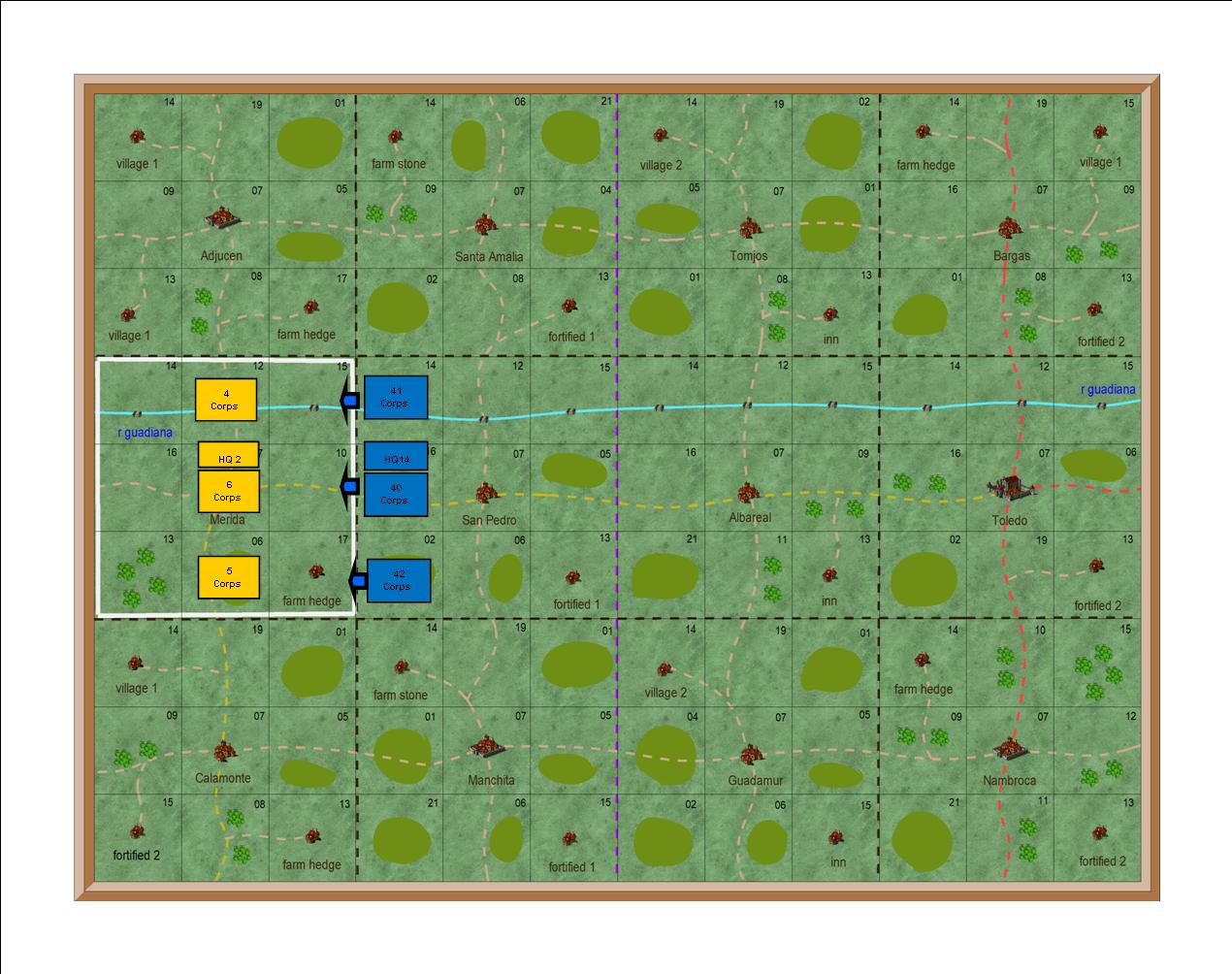
Battle of Merida on the campaign map 

First thanks to everyone who commented on my last post.   Your observations and suggestions are very welcome.   Thanks in particular to Bob Cordery who sent me a copy of his rules with permission to use them as required.   My new rules, like the previous ones, will eventually be published  as part of my 1813 campaign diary blog.   They will of course be free, and be available to anyone who wants to use them.

All of our wargames fight battles from our 1813 Napoleonic campaign.   It is important that the battles are easily moved from the campaign map to the wargames table and back.   To this end my campaign maps are a series of squares, which can be reproduced using the 2x2 scenic squares which make up my 6x6 foot wargames table.

Just before we moved to Spain in 2006 I started using Le Feu Sacre wargame rules.   As a commercial set of rules they were not ideal for my campaign concept.  But I really liked them and wanted to continue to use them.   This required considerable alteration over the years, but I have always been reasonably happy with the result.

17 years is a long time to use the same rules, particularly when you actually play most days for a couple of hours.   It says much for the design of LFS that they have lasted so long.   However over the past year or so I have become increasingly frustrated with them. 

To work with the campaign each wargame lasts a maximum of 12 moves, which equates with 12 hours in the campaign.   It has been obvious for some time that this is not long enough to reach a satisfactory conclusion to the wargame. 

Battle of Merida on the wargames table

Each wargames table represents a district in the campaign.   Each district has a town or city, and that is always the campaign objective.   Far too often a game results in a draw, mostly because the winner has beaten the enemy, but does not have sufficient time to take the town or city.

I have always been reluctant to create a new set of wargame rules.   I would rather adopt a commercial set.   However I have now decided that I will give it a go.

I will keep the current orders of battle, and the current campaign map system.   The one map square equals one table scenic square will remain.

When I created the campaign I knew exactly what I wanted to achieve.   The key was one square on the table to one square on the map.   So I recreated a series of maps which would reflect this.   

Now I want to create a set of wargames rules which are designed to achieve the game objective within 12 moves.  

By next week I hope to have an outline of how to achieve this objective.

Sunday, 16 April 2023

Wargame Rules Review


Campaign wargame map

All of my wargames are fighting battles from my 1813 campaign.   It is critical that the table is a replica of the wargames map.   The campaign battle area is three squares by three squares.   The wargame table is three squares by three squares.   One day in the campaign is 12 hours, each wargame is a maximum of 12 moves. 

When I started the campaign in 2009 I was using Le Feu Sacre rules by Too Fat Lardies.   I had to amend them slightly to fit the campaign requirements, but the mechanics were retained.   I did, and still do, regard them as an excellent set of wargame rules.   Over the years they have been amended time and again to suit my particular type of wargame.   I game against my wife Jan, and we game most days.   So we quickly gained a mastery of the fine points of the rules.   Few, if any, rules would stand up to this amount of play.   We quickly found bits which we did not like and which did not provide the type of fast moving and fun wargame.   However they still remain retain many, if not most, of the original rules.

However lately I have found that wargames are not completed satisfactorily in the maximum 12 moves.   This is partly because we both know the rules so well that  we can counter each move.    I usually take the offensive role, and I          have mastered what works and what  does not.   Jan has developed counter measures which usually result in a draw.   Most often I simply run out of time.    I “win” the battle, but fail to take the objective.  So, of course, I actually “lose” the battle.   Winning and losing does not matter, but the indecisive result does.   The campaign relies on a distinct winner and loser of each battle.   Remember that the aim of each battle is to provide an enjoyable wargame.   This is not the same as playing a realistic historical campaign.

So there is a pressing need for major change.  However I do not want to “throw the baby out with the bath water”.

I have a rough outline of what I want to achieve, but will take as long as it takes to play test  the result before I apply the new rules to the campaign.


Wargame Table

The main objective is to provide a more decisive result, but to keep the fast flowing and fun feel to the rules.   This is much more difficult to achieve than it sounds.  I have found so often in the past that any amendments to wargame rules produce many unanticipated and unwelcome problems.   You solve one problem but produce two more.

I feel that the need is to simplify the basic outcome of each combat, but maintain the overall balance of the rules.   However to do so I will need to alter the overall balance in order to adjust any minor problems of game play.

There are three major aspects I want to review

First combat in general

Second towns and woods

Third hills

At present combat is resolved by a table which confirms the outcome.  For example the winner breaks contact, it is a draw or the loser breaks contact.    Too often it is a draw, both sides suffer casualties, but the combat continues for two or three moves.

Towns are very difficult to take.   It takes a long time for the attacker to reach the building, and the fighting can then go on for two or three moves.   Most often the defender gets pushed back, but the attacker runs out of time.

Hills are particularly difficult to take.   Infantry can hide behind the crest and artillery dominates the approach.   The attacker has to reduce solve the artillery problem by cavalry or counter battery before the infantry can stand any reasonable chance of taking the hill.

That is the task.   Now all I have to do is solve the problem!

Sunday, 9 April 2023

End of Merida Campaign Phase


Battles fought during campaign phase

Suchet won four of the six battles fought.


He won the first three, forcing the Spanish army to retreat west to Adjucen, Merida and Calamonte.


To pursue the retreating Spanish, Suchet had to detach more infantry brigades to protect his every lengthening lines of supply.   This was necessary because of the increased guerrilla activity, which resulted in the loss of the town of Bargas – not once but twice.


The French won the fourth battle to the east of Adjucen.  However 2nd Spanish corps occupied the city, and 13th French army were forced to lay siege. 


The Spanish won at Calamonte, and also at the final critical battle of Merida.


By now the French were down to one or two days supplies for each corps, and the final blow was when the guerrilla captured Bargas for the second time.  This caused the collapse of the French supply system in the north. 


Suchet ordered his army to retreat east to resupply and regroup


Comments

The end of a campaign is always a time for reflection and to review lessons learned.   This was true at the end of the very first campaign phase in October 2009, it is no less true at the end of this campaign, which is the 85th campaign phase.


There are always good and bad aspects of each campaign.  The good aspect of this one is how well the Spanish guerrilla activity has affected the overall campaign.  I am not really sure whether this was luck or great skill at rule writing.  But I feel the narrative of this campaign has followed the historical war in the Peninsula very well.   The French swept all before them in the first half, but gradually ran out of steam (or more precisely supplies).   The guerrilla lost far more actions than they won, but the ones that they did win had a dramatic effect on the campaign.    The French really did run out of supplies, it was not just something I made up to bring the campaign to a dramatic end.   This was a really enjoyable campaign, one of the best so far.

The bad aspect is a general dissatisfaction with the whole concept of the campaign.   After 13-14 years of almost daily Wargaming the campaign battles it is not surprising that it is all getting a little tired.   Those of you who have followed my blog will know that I regularly revise both the campaign and wargame rules.   I feel that the time has come for yet  another major revision.   I have done this six times with the campaign, but the rules have changed very little.   I feel the time is right to perform major surgery on them.

At present is only a vague dissatisfaction with the outcome of recent games, and particularly in this campaign phase.   Over the next weeks I will put some serious thought into what I feel is necessary.   I will present my ideas and progress on the blog, so the campaign will be suspended until I have redesigned and play tested the new rule system.

I feel it is a bit sad to say that I am really excited at the prospect - but I am.

Sunday, 2 April 2023

Merida Campaign Day 7


15 June 1813 – Southern Spain – Day 7

French retreat to regroup and resupply


In the north 13th French army abandon the siege of Adjucen and retreat to Santa Amalia

1st guerrilla brigade occupy Bargas

4th French brigade retreat to Toledo

The French lines of supply is cut


In the centre 14th French army retreat to San Pedro


In the south 15th French army retreat to Manchita


The Spanish have won the Merida campaign


Comments

Having failed to take Merida, Marshal Suchet orders the Army of Spain to retreat


They will concentrate at Santa Amalia, San Pedro and Manchita to regroup

In doing so they will have occupied the three town on the Merida-Toledo border

Giron’s Spanish Army continue to hold Merida, and can claim victory


In effect the campaign has ended in a draw.


The French are unable to continue offensive operations and must break contact with the Spanish

However the Spanish are unable to pursue the French, let alone drive them out of Merida district


I am quite pleased with this confused end to the campaign, because it feels right.

It is very similar to the historical French experience in Spain

They could always defeat the Spanish field armies

But they struggled to exercise control over the captured cities and towns


I am also pleased with the guerrilla operations and French supply problems

It is this more than anything else which caused Soult to abandon the campaign


Sunday, 26 March 2023

Merida Campaign – Battle of Merida


Start of game

Merida is the main Spanish depot and the campaign objective

It is held and defended by 3rd Spanish army

14th French army have orders to take and hold Merida 


Both armies have suffered only light casualties in the campaign so far

Both commanders are well aware of the importance of Merida and the outcome of the battle


14th French Army – 10 infantry brigades, 3 cavalry brigade, 3 corps artillery

3rd Spanish Army – 12 infantry brigades, 1 cavalry brigade, 3 corps artillery

Battle of Merida – Move 12

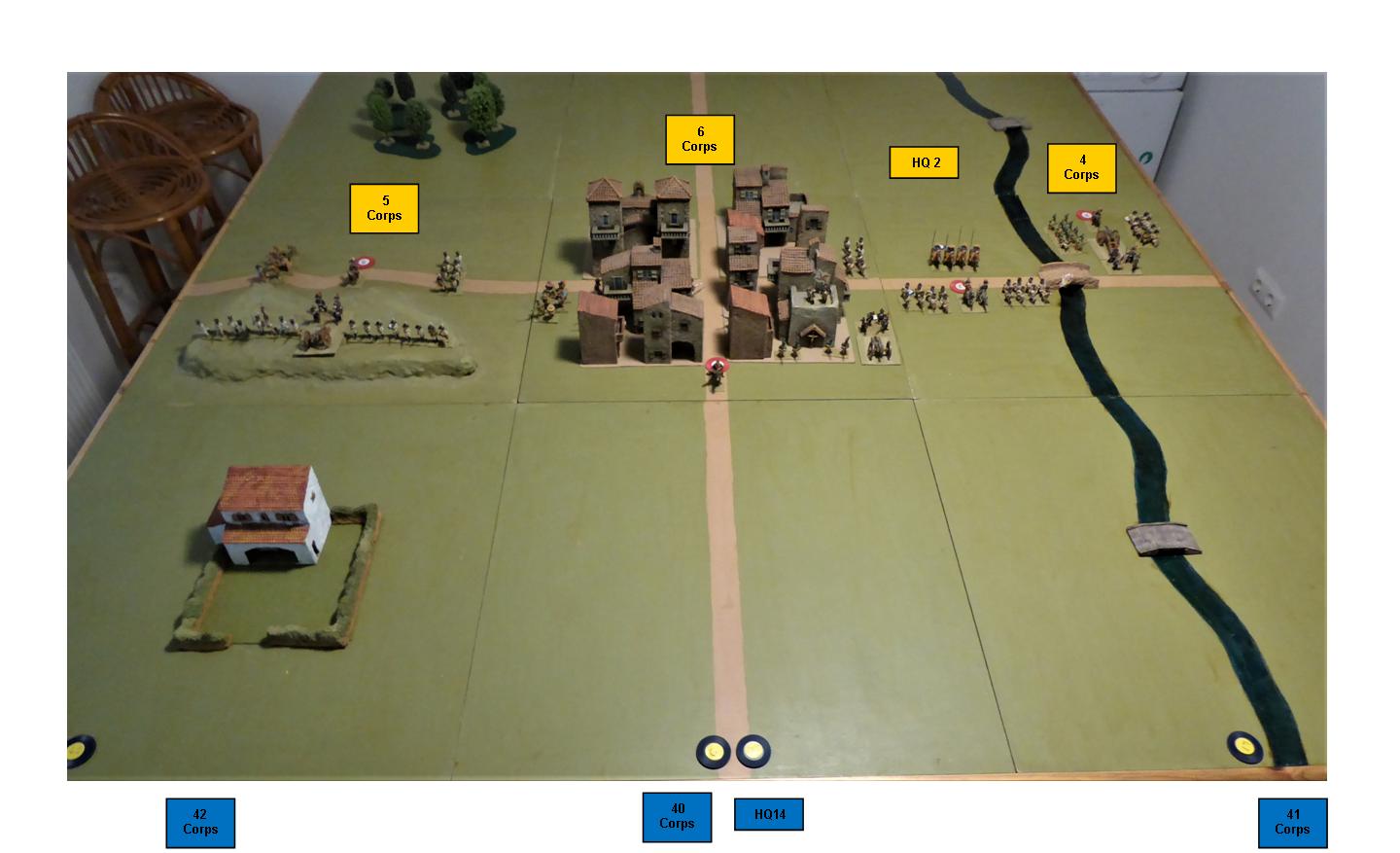
On the left most of 5th Spanish corps are in rout

Only one infantry brigade is left to hold the hill

However they have completely routed 42nd Polish corps


In the centre 40th French corps has fought to take the city

They have occupied the southern half.

But the Spanish still hold the northern half


On the right 4th Spanish corps have four of their six brigades in rout

However they have routed all six Baden corps

Not only do they hold the flank, but they are sending reinforcements to the city


The French have lost 13 infantry and 5 cavalry casualties (5700 men)

The Spanish have lost 17 infantry, 2 cavalry and 5 artillery casualties (7500 men)


The French have 8 brigades in rout

The Spanish have 10 brigades in rout


Against all the odds, the Spanish have won a convincing and decisive victory


Comments

This was easily the hardest fought wargame of the campaign

Indeed the “nearest run thing” for many a campaign.


Both players were determined to win, knowing that the winner would also win the campaign

Neither side had many campaign casualties, so morale was strong for both armies

In the first photo the Spanish deployment looks very similar to the previous five battles


The French tactics were very similar to earlier games.

The CinC took command of two of the three corps artillery

He also took two elite infantry brigades

The battle plan was to hold the flanks with 41st and 42nd corps

And take the city with 40th French corps plus extra artillery


The fighting was really fierce and undecided until the very end

The French made steady progress, but suffered heavy casualties

The Spanish also lost heavy casualties


The Spanish held both flanks, but that was more luck than skill


On the left the last Spanish infantry brigade held the hill in line

Their artillery routed, but then rallied and were about to reoccupy their guns

The two remaining French infantry brigades had to attack in column before they could do so

The Spanish brigade just happened to be the best one in 5th corps

The two French brigades just happened to be the two worse Polish brigades

The Poles lost and ran away.


On the right the Baden cavalry routed with just 10% casualties (one hit)

This allowed 4th Spanish corps artillery to redeploy and fire on the Baden infantry

The attack on the bridge ended in disaster with all six Baden brigades in rout


But it was in the centre where the Spanish really won the battle

6th Spanish corps held the southern half of the city, but did not garrison the northern half

The French grand battery deployed at short range, with the two infantry brigades in support

However as soon as they opened fire the Spanish garrison withdrew to the northern half of Merida

The French artillery had failed to cause any casualties to the garrison]

And were now unable to fire on the northern half of the city

There were five French brigades ready to assault the town

But on one could attack through each town section

Because the Spanish still held the flanks they could not easily attack the east and west sides of Merida.

The French artillery finally redeployed against the northern half of the city

They opened fire again on move 12 (the last one of the game)

One hit and caused the garrison to take morale

They passed their test, held the city and won the campaign


One of our most enjoyable wargames for a long time

And a great way to decide a very enjoyable campaign phase.

Saturday, 25 March 2023

Merida Campaign Day 6


14 June 1813 – Southern Spain – Day 6


Siege of Adjucen day 2

14th French army attack Merida


In the north 38th and 39th French corps retreat to Santa Amalia to resupply

1st guerrilla attack Bargas, garrison rout with 20%, supplies lost

2nd guerrilla attack convoy to Tomjos, lose 10% and rout, supplies delivered


In the centre 14th French army attack Merida

3rd guerrilla attack Toledo, fail and retreat with casualties

4th guerrilla attack convoy near Albareal, lose 10% and rout, supplies delivered


In the south 15th French army rally, regroup and resupply after battle of Calamonte

3rd Spanish army regroup in and around Calamonte

6th guerrilla attack Guadamur, fail and rout with 10% casualties


Comments


This is crunch day for the French.


All nine corps are running short of supplies, many with just one day left.

If they run out of supplies they will start to lose attrition casualties at the rate of one per corps per day


In addition both the French and Spanish troops are tired and in desperate need of rest and reinforcements

By nightfall they will have fought six major battles in six days.  


The battle of Merida is their last chance to crush the Spanish army and take the campaign objective

The loss of Merida and its supply depot will force the Spanish army to retreat west.

However if they hold Merida their lines of supply are secured

It will be the French who are forced to retreat.


The daily guerrilla activity is also having a serious effect on French morale

Once more they have captured Bargas and its supplies

The garrison have now lost 20% casualties, and been forced to rout twice

Even when the French reoccupy the town, as they must, they will have to detach another brigade from their field force


Both sides are aware of the importance of Merida

Both will fight hard to occupy the town and thus win the campaign.