Sunday, 15 January 2023

Merida Campaign Day 1


9 June 1813 – Southern Spain – Day 1

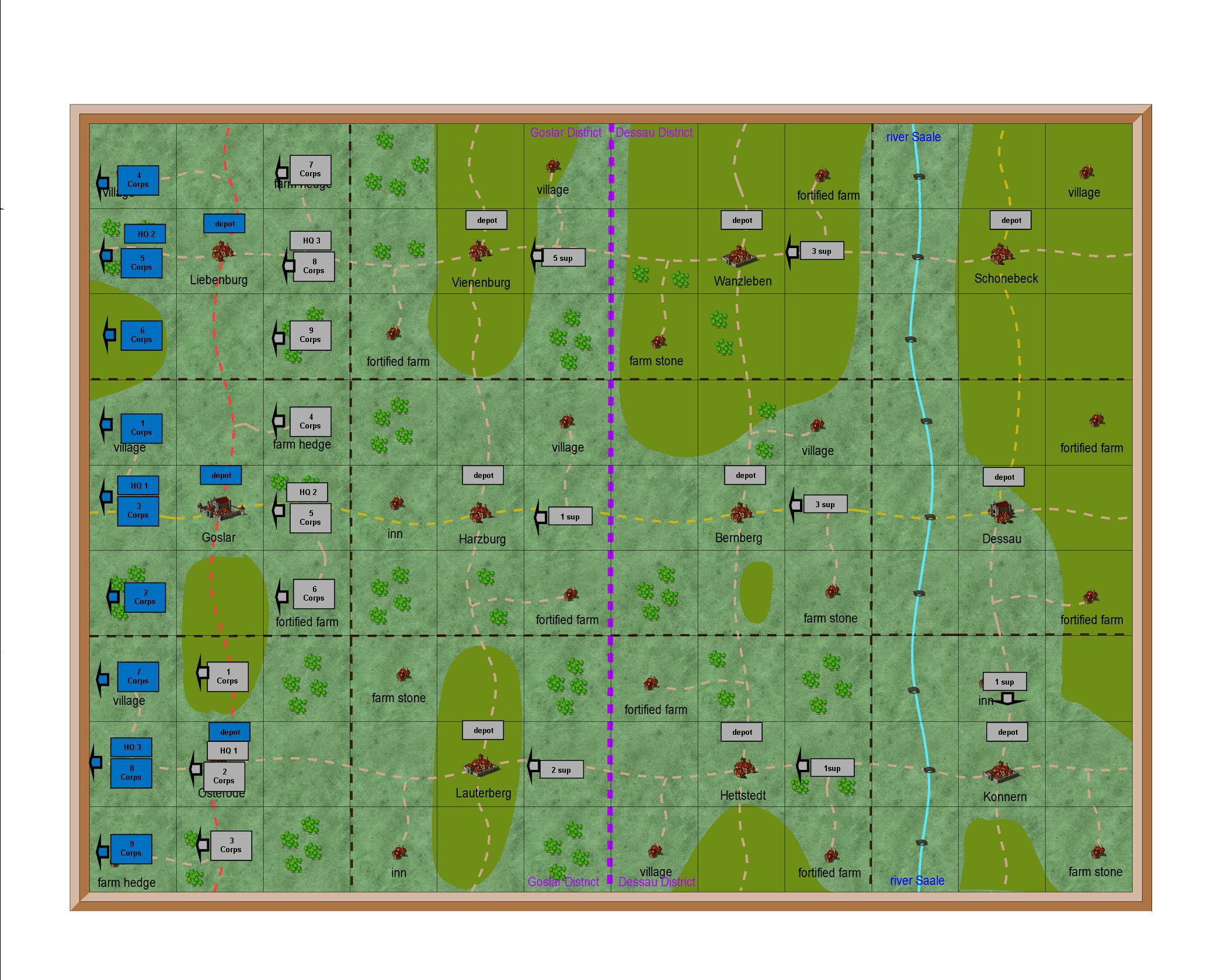
The Spanish army deployed west of the Merida-Toledo district border.

Three corps occupy the border towns of Santa Amalia, San Pedro and Manchita.  

However they are not close enough to prevent the French crossing the border.

The remaining three corps are further west in Adjucen, Merida and Calamonte.


The French army are closer to the border, and all nine corps are deployed to attack


The campaign opens in the north where 13th French army attack Santa Amalia


Comments

The Spanish army are deployed in a defensive position.  

Their have three corps observing the border

But the remaining six corps are in reserve

This deployment makes it much easier to supply all nine corps

But there will be a delay of 4 and 8 hours for  the reserve corps to reach the front


The French army have concentrated in preparation for an advance into Merida region  

The three forward corps are in contact with the Spanish

The remaining six corps are out of sight, but can reach the border within 4 hours.

This deployment makes resupply more difficult.


The French have occupied all of the towns in Toledo region.

The Spanish garrisons of those towns have formed guerrilla brigades

Each of these brigades must operate within one square of their original town

For example 1 militia brigade was the garrison of Bargas

They must remain within one square of that town.


Each French corps can carry a maximum of four days supplies

Each Spanish corps, and militia brigade, can carry only three days

This gives the French a considerable movement advantage

It also allows them to go one day more without resupply


The entire French army have a minimum of 51 days supply

This is 36 with the corps and a reserve of 15 in the supply depots

This reserve is to allow time for supplies to be moved to each corps


The entire Spanish army has a minimum reserve of 38 days

This is 27 with the corps and a reserve of 11 days supply


Each town gathers one days supply each day

Any surplus required to make the daily minimum is received by the main supply base

This is Toledo for the French and Merida for the Spanish

Sunday, 8 January 2023

Happy New Year


We have just returned from the UK, having spent Christmas and New Year with our son and his family.

This was our first visit to the UK since December 2019, due of course to Covid

It was also the first time since then that I have been separated not only from my computer, but also our wargame

This will explain why I have not posted on the blog for three weeks


It is not a bad thing to have a complete break from our normal weekly routine

This includes, of course, not only the 1813 campaign but also the wargames table.

However I found that I really missed the weekly routine, though not so much the Wargaming and campaign

In fact it was a relief not to have to meet the weekly deadline to post on this blog and the 1813 campaign blog.


For the past 16 years our weekly routine has been dominated by Wargaming and our hill walking group

Jan and I have been walking in this part of Spain since we moved here in 2006

Having gained a comprehensive knowledge of the local walks we formed a walking group through the local U3A

Membership is mostly British ex pats, but also Dutch, Belgian and German.

Strangely no Spanish members.    This is not intentional on our part, but none have applied to join.


Over the years Jan and I have developed a pretty strict weekly routine

Monday we lead the hill walking group

Tuesday we visit the local town (Jalon) for the twice weekly shop

Wednesday I post the weekly walking blog and also the U3A and Jalon Facebook

Thursday I plan the next Monday walk and send an email to all members

Friday we visit the larger coastal town (Calpe) for our second weekly shop

Saturday I collate replies and prepare a map of the Monday walk

Sunday I rest!


The wargame fits in between the daily routine

Most afternoons we spend an hour or two Wargaming

When a game is completed I then spend the best part of one day updating the campaign

The next day I set up the next game


The above had resulted in a busy, but not hectic, weekly routine which suits us both very well

It is a good mixture of physical and mental activity


A year ago I started a new project, which has been very time consuming

I start the walking blog in 2009, and I take about 20 photos on each walk for the weekly blog

A couple of years ago a friend suggested that I make YouTube videos of them

At first it was intended to be an annual review, with about two photos from each walk

But gradually it extended and I am now making 6 to 10 videos of each month

At present I am up to 2018 and have done 131 visdeos.

I really enjoy making the videos, which are then available to friends and family to watch

Jan and I also watch one most days.

However this resulted in even less time for our Wargaming activities


Three months ago Jan went to see our doctor about increasing back pain

X-rays confirmed a couple of herniated discs

It is not life threatening, but it is very painful

The doctor confirmed she must take it easy until she can see a specialist

This meant she could no longer do our weekly hill walking, at least until her specialist appointment

This was a serious problem, because the walking group are our main social group


I didn’t want to stop the hill walking group, but I decided to start a second group

This would meet on a Thursday, and do easier three hour low level walks on good tracks

It has been very popular, and now has a membership of 20

For Jan it offers both regular exercise and a new set of walking friends

However it does double the amount of time I spend on administration.


The main casualty has been the 1813 campaign and this blog

We do try to fit in as much Wargaming as before, but it is very difficult

I find that we have to make a real effort to Wargaming each afternoon

And I never seem to have time to update the campaign.


I have always maintained that we find the time to do the things we really want to do

It is, of course, always a matter of priorities

And at present Wargaming has slipped from equal first priority to poor fourth priority


There is no chance that I will abandon my Wargaming entirely

But it may take a few months before I can find sufficient time to do it properly

At my present rate I should complete the backlog of the walking videos in about March

I will still have to produce two or three videos each month, but that will only take as many days

I should then have sufficient capacity to give the Wargaming the time it requires and deserves.


This problem is, of course, entirely self created

But I do enjoy all four projects and I am reluctant to give any of them up

And I am confident that I will be able to solve it by better time management


I plan to keep both this blog and the campaign blog going

I hope to post here each week, and at least once a week on the 1813 campaign blog.

You will be the first to know if I fail to do so


Happy New Year one and all


Sunday, 18 December 2022

Merida Campaign Phase

Map of Spain

This map shows the location of the four army groups in Spain.  

Each square is a military district.  

Nine squares is a military region.  

The stars show the location of previous campaigns fought in Spain. 

The colour of the star indicates which side won.  


The white star shows the location of Merida

This map shows the current location of the four armies.
The colour of stars indicated which army has won the previous campaign phases.    

Map of South Spain

This map shows the location of the French and Spanish army.  

Each square is a military district.  

Nine squares is a military region.  

The stars show the location of previous campaigns fought in Spain. 

The colour of the star indicates which side won


There are three regions in Southern Spain

Lisbon Region (on the left) is held by the Portuguese army

Valencia Region (on the right) is the held by irregular Spanish forces        

Seville Region is the disputed area in the middle


This map shows the current location of the French and Spanish armies

Seville Region

This map shows the location of the French and Spanish army. 

Each square is a military district.  

Nine squares is a military region.  

The stars show the location of previous campaigns fought in Spain. 

The colour of the star indicates which side won


This map is used for strategic (planning) movement.


Merida/Toledo District

This map shows the campaign area

It covers the area between Merida and Toledo

The district border is in the middle of the map


It shows the location of each French and Spanish corps.

It also shows depots and detached brigades

Each square is a 2x2 foot scenic square.  

Nine squares is a wargames table.  

Nine squares is also a military district.   


This map is used for tactical (daily) movement


The Spanish objective is to hold the city of Merida

The French objective is to defeat the Spanish army

Comments

This is the 84th campaign phase since the 1813 campaign started in April 2009

It is the 12th campaign phase since the campaign was last revised in June 2020

The last revision resulted in new maps showing military regions and districts


This is also the second campaign phase since the introduction of nine corps per side instead of six

The increased armies has required considerable change to the administration of the campaign

It is still being play tested, but after one campaign phase had greatly improved the wargames resulting from the campaign


The major change is supply and depots.

There are twelve towns on the campaign map, the same number of corps in the previous order of battle

Until now one town supplied one days supplies for each corps

Now that there are nine corps per side the depot has to supply the extra three days per side

This has required new supply rules to avoid the administration becoming too complicated


In the previous campaign, set in northern Germany, this worked well

However in Spain there is the additional complication of guerrilla groups.

Their function is to attack French garrisons and convoys

The garrisons remain the same, but the number of convoys has increased

Consequently the rules for the guerrilla has had to be rewritten.


The main change is that each guerrilla band will be able to attack one day in three

The other two they will be moving back to their village, resupplying and regrouping


I want the guerrilla to have an influence on the campaign, but not to dominate it

The rules have been simplified to allow for more guerrilla attacks than previously

Each time a depot is attacked the French will be unable to gather one days supplies

An attack on a convoy will only affect the French if the guerrilla are able to capture it

All casualties, both French and Spanish, will automatically be replaced by the respective field armies

This means both guerrilla bands and French garrison will always be full strength

But for each casualty one brigade in the respective field army will lose 10% casualties


As always, these new rules will be revised at the end of the campaign phase.


Sunday, 11 December 2022

End of Goslar Campaign


Goslar Campaign Area

There were six battles fought, the Prussians won four and the French just two.


The campaign objective, the city of Goslar, was held by the French throughout the campaign.  

But by the end of the campaign Blucher has taken Osterode and routed Third French Army and outnumbered the French three to two.

Brunswick Region

There have been three campaigns in the Brunswick Region since the Sixth Campaign began

in September 2020.  

The French won two and the Prussians just one.

Of the 17 battles fought the French won ten and the Prussians seven

Europe

Since the 1813 campaign began in April 2009 there have been 16 campaign phases fought in Northern Europe between Napoleon and Blucher.  

The French won eight and the Prussians also eight.


Comments

At first sight this campaign, which began two years ago, was unusual in that Napoleon was beaten by Blucher.

In this current campaign the French beat the Prussians two campaigns to one

They also won ten battles and the Prussians only seven


However throughout the whole 1813 campaign, which began 13 years ago, both sides won 8 phases.


The French have the Imperial Garde corps, which has better quality troops than any of the Prussians corps

However when both armies are compared the number of elite brigades is similar.


One of my objectives in planning the 1813 campaign was that both sides should be equal

The campaign is designed to provide interesting battles to wargame.

So it was important that formations like the Imperial Garde should not win every battle

It would be possible, but a lot of work, to determine how many of their battles they did in fact win

But the fact that the French and Prussians each won eight phases seems to indicate that  I was reasonably successful.

Sunday, 4 December 2022

Goslar Campaign Day 7


7 June 1813 – Northern Germany – Day 7


French retreat and abandon Goslar and Liebenburg

In the north French abandon Liebenburg

In the centre French abandon Goslar

In the south Prussians occupy Osterode

Prussians win Goslar campaign


Comment


Before the battle of Osterode things were looking bleak for Napoleon.

However he still held the three western towns of Leibenburg, Goslar and Osterode.

Both armies were weary after six days of hard fighting

However the French had taken the brunt of the damage.


Murat’s report made it clear that he had suffered a dramatic defeat at Osterode

Half of Third Army was in rout, the remainder in retreat.


Napoleon issued orders for First Army to hold Goslar and Second Army Liebenburg

Murat was to rally west of Osterode and prepare to counter attack


However on the morning of 7 June he received reports that the entire Prussian army was advancing

Blucher ignored his low supplies and heavy battle casualties

He could clearly see that one more push would force Napoleon to retreat

At first light he led his entire army west towards Goslar


Even Napoleon now had to admit defeat

His army was outnumbered three to two

His right flank had routed

If he tried to fight again he would almost certainly lose the entire French Army of the North

He ordered a general retreat and abandoned Goslar and Liebenburg


The Prussians had won the Goslar campaign.


Sunday, 27 November 2022

Goslar Campaign Day 6


6 June 1813 – Northern Germany – Day 6

Prussians attack Osterode

In the north both armies rest and reorganise

In the centre French retreat to Goslar

In the south Prussians attack Osterode

Battle of Osterode – Move 10

The battle opened with the French deployed just in front of Osterode

As the Prussians entered the table the French occupied the woods on either flank

However they held their centre back

This proved a mistake, because the Prussians could outflank the woods


The Prussians lost the first cavalry melee on their right

This forced them to hold back their attack on the woods

Only when the French started to retreat did 1st corps advance


On the opposite flank they had more success

Here the cavalry melee was a draw, and both brigades withdrew

The Prussian infantry and artillery pressed home their attack on the woods

Fighting continued until nightfall, but the French suffered more casualties


The Main attack was in the centre.  

Kleist took the grenadier brigade from each corps to form the main attack

Supported by 2nd corps he managed to break the French centre

This forces both flanks to withdraw and gave him a convincing victory


Comment

In this campaign it would appear that the French can do no right

Despite having the Imperial Garde and Napoleon in command


This game was decided within two moves

The French had woods on both flanks, with open ground in the centre

They could deploy behind the woods, half way in or hold the whole woods

They decided on the latter, but left their centre where it started the game


The woods are a strong point, but they are difficult to defend

Prussian artillery could approach within short range of the woods

They could then blast the forward infantry brigade in the woods


To counter this the French cavalry had to be brought forward

This would deter the Prussian gunners from getting too near the woods

But it would then present the Prussian gunners with the cavalry for a target


As always the initiative is with the attacker

He can take advantage of any deployment error

The commander can also take brigades from the three corps

This strong reserve can then be directed at the weak part of the defence.


During this campaign I have usually been the attacker

This is because Jan prefers to react

I have found that the opening moves are where the attacker is most vulnerable

He must advance into artillery range of the defender, and in doing so accept first fire

If he loses either cavalry or artillery, it becomes almost impossible to attack.


He has two or three moves to fire on the enemy

If he takes longer he will arrive too late to take the objective

If his guns do not cause damage to the defenders he must risk his cavalry

Unless he can weaken the enemy guns he will probably take heavy infantry casualties

This will usually result in an early cavalry melee


Cavalry melee will usually result in both sides taking casualties

This will weaken both brigades, who then usually retreat behind the infantry

If the defender wins the cavalry melee it will be very difficult for the attacking infantry to advance.


The advantage of my new three corps per side is that each corps has its own cavalry

It is most unlikely that one side will win all three cavalry melee

The attacker will usually win at least one melee

He can then use his reserve to support the winning side


This makes for an interesting wargame

The attacker must hold his reserve in the centre

From here he can support whichever wing wins the cavalry melee


His greatest problem is to force a break through early enough to reach the objective

This has proved the most difficult thing to achieve in this campaign

It has often resulted in the defender holding the objective at nightfall

However to do so he has lost more casualties than the attacker

But by holding the objective he has won the game.


This should result in a second day of battle

But that is usually a very boring wargame

The stronger attacker can redeploy overnight

Within three or four moves he will have broken the weaker defender

I usually avoid this outcome by having the weaker defender retreat overnight.

Sunday, 20 November 2022

Goslar Campaign Day 5


5 June 1813 – Northern Germany – Day 5

French attack Harzburg

In the north surprise French attack on Harzburg

In the centre French prepare Liebenburg for a siege

In the south both armies regroup and resupply

Second battle of Harzburg Move 12

The French plan was to pin the Prussian left

The main attack would be in the centre against Harzburg

The Guard would crush the Prussian right and support the centre

The Prussians put up a fierce resistance and held their centre and left

Their right was broken, but delayed the Guard until it was too late to take the town

At nightfall they still held Harzburg and won the battle


Comment

The situation is becoming desperate for the French

The Prussian army has crossed into Goslar district and is poised to take Goslar itself.

Fortunately the city is defended by 1st French army, including the 1st Guard corps.


Napoleon orders 1st army to attack 2nd Prussian army at Harzburg

The aim is to break the Prussian centre, or at least disrupt their plans to attack Goslar.


The attack quickly becomes bogged down.

On the right 3rd corps are quickly repulsed and only just hold the flank

The main attack in the centre is a dismal failure, including the reserve commanded by Napoleon

But on the left the Imperial Garde brush aside 4th Prussian corps and attack the city

Unfortunately the run out of time and the Prussians still hole Harzburg at nightfall.


I commanded the French, and it was a real pleasure to see the Imperial Garde on the table

The dice rolled well for them, and allowed them to crush the Prussians as you would expect them to do

However it was only fair that they failed to take Harzburg

For Jan, who commanded the Prussians, defeated two thirds of the French army

And without doubt deserved to win the game.


I am really pleased with the type of game provided by the larger armies

In effect there are three games being fought at the same time

And it is most unlikely that one side will win all three

Often the game is won by the side who win the centre of the three battles

They can then move to support whichever flank is having the most success

However, as in this case, it is often too late to take the objective within the 12 moves allowed.