Sunday, 27 March 2022

Gera Campaign – Day 7


7 May 1813 – Central Germany – Day 7

Both armies are nearing the end of their operational ability

Despite heavy fighting over the past 4 days, neither side has gained an advantage.

It is becoming clear that the French will not be able to achieve their campaign objective of taking Gera


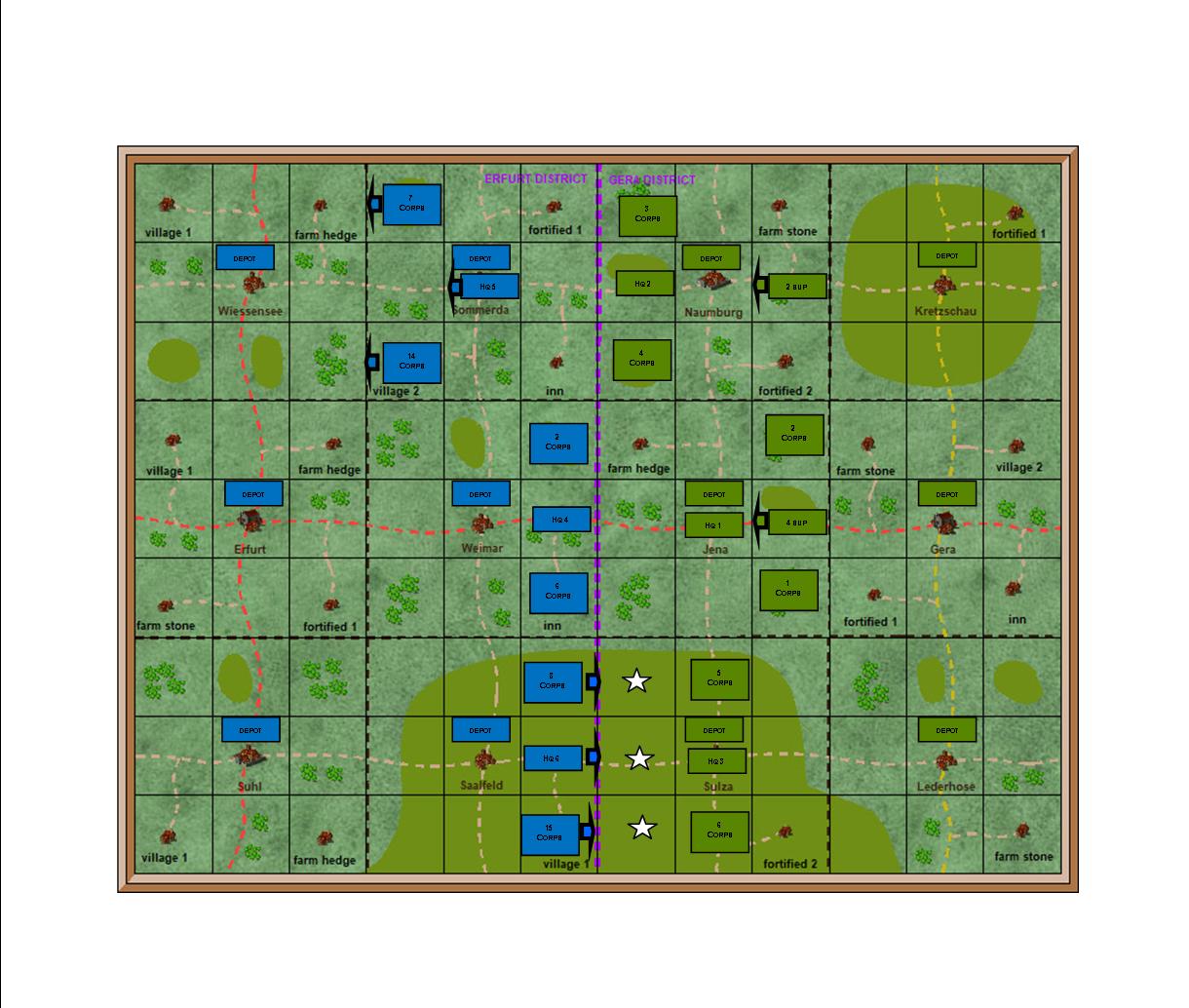
In the north French retreat to Sommerda, Russians regroup at Naumburg

In the centre Russians rally at Jena, French resupply at Weimar

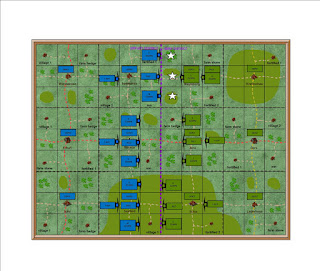
In the south French attack Sulza


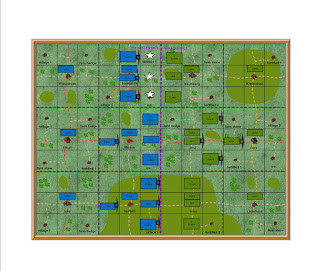
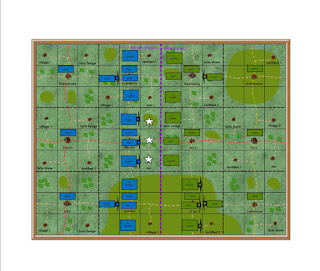
Battle of Sulza

To secure the border Marshal Davout orders 6th French army to take Sulza.

A victory would at least secure a foothold in the District of Gera


Both armies start the battle with considerable battle casualties

MacDonald is aware that with such brittle morale he cannot risk heavy casualties

As attacker, this presents a difficult problem.


A depleted 8th French corps will hold the mountainous northern section

He creates a reserve of three infantry and one cavalry brigades

This will form the spearhead of his attack.

15th Vistula corps will support the attack in the south.


He deploys his army out of artillery range of 3rd Russian army

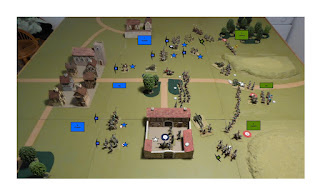
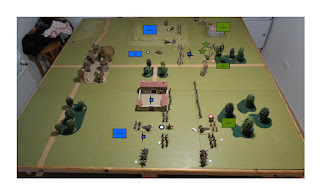
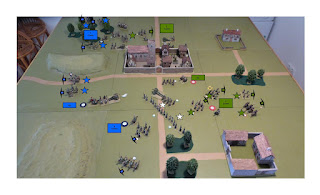
His corps artillery advance into range of the Russian infantry and open fire

The Russian guns reply, but do little damage


The French reserve advance in the centre

The Vistula lancers move forward to threaten the enemy artillery

Russian Cossacks charge the lancers, but lose the melee and rout

A nearby Russian infantry brigade lose their resulting morale test and join the rout

The Russian gunners abandon their guns and take cover in the remaining infantry square


By midday it is clear to Winzingerode that he cannot hope to hold the French

With two infantry and one cavalry brigade in rout he orders the rest of his army to withdraw

One infantry brigade will hold Sulza until nightfall, and will then retreat to join the rest of the army


The Russians have lost 3 infantry and 1 cavalry casualties (1300 men)

The French have suffered no casualties

Comment

The outcome of this battle was decided solely on morale

Almost every brigade in both armies had at least 10% casualties from earlier battles

This left them very vulnerable if forced to take a morale test

It also made it very likely that if one brigade were to rout, the supporting brigades might well join them


So the French commander held his infantry and cavalry out of artillery range of the Russian army

He then advanced his artillery to long range of the Russian infantry, who had to hold their ground to protect their guns

His intention was to weaken the infantry with artillery fire, and then attack with infantry and cavalry.

The only reply open to the Russian gunners was to fire on the difficult to hit French gunners


Only one Russian infantry brigade was hit, and it lost its morale and routed

Fortunately their supporting brigades passed their morale test.


The French infantry would now have to advance to take Sulza

This meant moving into range of the Russian gunners

Only the French reserve advanced, the two corps on the flanks held their ground


The Russian infantry brigade which had routed left one of the Russian batteries uncovered.

The Vistula lancers advanced to threaten these guns, and the supporting Cossack brigade counter charged

The Poles won the melee, and routed the Cossacks

A nearby Russian infantry brigade had to test their morale, failed and joined the Cossacks

The Russian gunners had to abandon their guns and seek shelter in a nearby infantry square.


As the result of one cavalry melee the Russian centre was broken, without a single French casualty


The remainder of the Russian army was now seriously outnumbered and withdrew before the French could reach them


However this battle could just as easily have gone the other way


If the Russians infantry square had not broken things would have gone very different

The Vistula lancers could not have charged the Russian infantry

They would have come under artillery fire to get within charge range of the Cossacks

Possibly lost casualties, cavalry melee should have resulted in a draw at best

French infantry would have had to march towards the guns

Would almost certainly have lost at least one infantry brigade

May well have lost more due to failure of morale.


Should have been a Russian victory


Turned out to be a French one


Sunday, 20 March 2022

Gera Campaign – Day 6


6 May 1813 – Central Germany – Day 6

The campaign is going badly for the French

By now they should be in position to attack Gera

But they are still west of the border

In the centre and south they have finally forced the Russians to retreat

However to move into Gera district they must take Naumburg


In the north French army attack Russians west of Naumburg

In the centre French regroup, Russians retreat behind Jena

In the south French army advance to make contact with Russians at Sulza

Second Battle of Naumburg

Both armies start the battle with considerable casualties from previous battles.

Lefebvre is aware that his army is not strong enough to launch a frontal attack

He orders both corps to move to the centre and support the main attack.

This is spearheaded by the reserve of two infantry brigades and one corps artillery


The reserve artillery is routed by the Russian gunners

This causes the central attack to stall until the redeployment is complete


Constantine reacts to the French redeployment by retiring his right and centre

The right retreat into the woods, the centre to the valley between the two hills

On his left 4th corps move down from the hill and join the centre


The Russian gunners concentrate on the French cavalry, and rout both

This spreads to two infantry brigades, and 5th corps artillery


Without cavalry or artillery support the French infantry must withdraw


French lost 1 infantry, 1 cavalry and 2 gunners (700 men)

Russians lost 1 infantry (400 men)


Comment

After four battles both armies have suffered considerable casualties.

Even with reinforcements most brigades have at least 10% casualties

This would have a significant effect on this battle.


It would have more effect on the French, who would have to attack

They would have to accept some artillery casualties as they approached the Russian position

The French commander was aware that they could not risk a frontal attack

He ordered a redeployment towards the centre, where the reserve would spearhead the attack.


Obviously the Russians reacted with their own redeployment

They withdrew to a strong position in the centre at the entrance to the valley

Their left wing retreated to the woods, their right moved down from the southern hill to extend the centre


The battle was decided with relatively few French casualties

The Russian gunners were lucky with their dice, and hit the Westphalian artillery and French cavalry

Both failed their morale due to battle casualties, both broke and routed

Both routs spread to nearby brigades, who already had battle casualties


Only one infantry melee took place, when the Russian infantry stormed the inn in the centre

They won, but it had little effect on the outcome of the battle


This battle could have gone either way, the Russians were luckier on the day


The French really needed to win this battle, and the outlook is now bleak for them

Sunday, 13 March 2022

Gera Campaign – Day 5


5 May 1813 – Central Germany – Day 5

The campaign is not going well for the French

They had anticipated that by now they would have taken the three border towns of Naumburg, Jena and Sulza.  

All three are still held by the Russians.


In the north both armies regroup and resupply

In the centre 4th French army attack Jena

In the south the Russians retreat to Sulza.

Battle of Jena

The battle is fought to the west of Jena.

The French advance in three columns

In the north 2nd (Young Guard) corps

In the centre a reserve of three infantry brigades and corps artillery

In the south 6th French corps


The battle opens with an exchange of artillery fire, which causes little damage

2nd corps occupy the northern hill, but do not attack

6th corps attack in the south, but are unable to break 1st Russian corps

The battle is decided by the fight in the centre between the two reserves


The French 12pdr guns dominate the 6pdr Russian guns

At midday the French infantry advance, and rout the shaken Russian gunners


Having broken the Russian centre the French artillery redeploy to support 2nd corps. 

Before they can attack the Russian army retreats.


The French claim victory, but the Russians are not defeated

At nightfall they still hold Jena and both corps are in good order


The French have lost 2 infantry and 1 cavalry casualties (900 men)

The Russians have lost 3 infantry, 1 cavalry and 2 artillery casualties (1500 men)


Comment

Marshal Davout is well aware how critical this battle would be.

Each army has won one battle so far in the campaign

However the French have failed to drive the Russians back from the border

If they lose this battle and retreat they have failed in their campaign objective


With both armies on the table at the start of the game no time was lost in deployment

By move two the French artillery were in range of the Russian gunners

After four rounds of artillery fire little damage had been done


In the north Davout did not want to risk heavy casualties to his elite 2nd Young Guard corps

He advanced his infantry on the high ground, out of sight of the Russian guns

Their cavalry advanced in the valley to cover their flank

But were careful not to approach too close to the Russian guns or heavy cavalry

They were waiting for the French reserve to come to their support


In the centre both armies had created a reserve of three infantry brigade and corps artillery

The winner here would be able to support either the northern or southern wing


In the south 6th French and 1st Russian corps were evenly matched

Neither had managed to gain artillery superiority

Finally the French  had to advance and move into Russian artillery range

Their cavalry charged the Russian Cossacks, expecting a quick victory

However they lost the cavalry melee and had to retreat shaken

The unsupported French infantry quickly retired


The battle in the centre was decided by the French 12pdr artillery

They outranged the smaller 6pdr Russian guns

They were able to move into close range of the Russian guns and pound them

As soon as the Russian gunners were shaken the infantry advanced and routed them


Although the Russians retired, they did so in good order and still holding Jena

Sunday, 6 March 2022

Gera Campaign – Day 4


4 May 1813 – Central Germany – Day 4

Having won the battle of Naumburg, the whole Russian army moves forward to the border.  

In the south Third army cross the border and launch a surprise attacks on Saalfeld.

After a hard fought battle the French hold the town 

Battle of Saalfeld

The Russians create a reserve of both corps artillery and two elite infantry brigades.   The French reserve is two elite infantry brigades allocated to hold the town.

The Russians have to advance through the hills to reach Saalfeld.   This results in a slow deployment, except for the reserve artillery who use the only available road to deploy first.

The French are deployed on the hills either side of the town, and happy to wait for the Russian attack.  The reserve artillery remain behind the town to avoid the Russian artillery deployed in front of Saalfeld.

In the north, 8th French corps has to advance into the plain, to disrupt the Russian reserve.   5th Russian corps attack, but are driven back with heavy casualties

In the south the Russians remain behind the crest of the hill.   6th Russian corps attack, and have more success than in the north.  But at nightfall the hill is still disputed.

So the battle is decided in the centre.   The Russian refusal to garrison the town protects the reserve infantry.   The French reserve infantry suffer heavy casualties as they approach the town, and are too weak to attack.   At nightfall the French still hold the town, and claim victory.

Comment

It is interesting how the campaign takes on a life of its own.   The intention of this campaign phase was that the French would move east into Gera district, with the objective to taking Gera itself.

This would mean that the initial fighting would take place at Naumburg, Jena and Sulza.   However the Russian victory at Naumburg dictated that the Russians should take the initiative and march into Erfurt district. 

This in effect would make it the Erfurt campaign phase, not the Gera campaign phase!

So this battle, even though it was very early in the campaign phase, was critical.   If the Russians won at Saalfeld it would be extremely difficult for the French to hold the line of the border.  They would have to retreat to Wissensee, Erfurt and Suhl.

The latest winning tactic is for the attacker to create a very strong reserve, usually infantry and artillery, under the command of the Army commander.   The defender has to defend the whole front, leaving the point of attack to the attacker.   Using the reserve the attacking general can choose which of the two wings to support, giving them a high likehood of winning.

The counter is for the defender to do the same.   The game objective is always the town, so the defender must use his reverse to hold it.  By putting his infantry into the town, he presents an excellet target to the attacker.   He can move his artillery into close range of the town, batter the garrison and then attack with his reserve infantry when they have received sufficient casualties.

In this game the French defender (Jan) found a winning counter to this tactic.   She created a reserve of two elite infantry brigades.  But they were placed behind the town, not inside it.   The two corps either side of the town deployed their artillery close to the town, providing long range support.

As the Russian reserve advanced they came under fire from the French artillery.   There was no one in the town, and the enemy infantry was behind the crest of the hills on either side.  So the Russian artillery had no targets, other than the difficult to hit French gunners.   However Russian infantry had to be close enough to support the reserve artillery, and therefore were within range of the Russian gunners.  They suffered heavy casualties, and were too weak to attack the town.

Had the Russian reserve infantry stormed the town early in the battle, they would have suffered even more casualties from the French artillery.  And the French reserve infantry could have entered the town at the same time as the attackers, thus preventing the Russian artillery from firing on them.

This simple tactic won the game for the French.   And it presented a very effective to the previous battle winning attacker reserve.   It will be interesting to see if we can come up with a counter to the counter!

Sunday, 27 February 2022

Sale of AB Figures


Anglo-Portuguese Army

Finding a new owner for my AB Napoleonic army has proved far more complicated and disappointing that I ever imagined it would be.

I have not attempted to sell any figures for more than 20 years, and even then it had proved to be a complicated and time consuming operation.   At that time I was upgrading my 25mm and 15mm armies to 28mm and 18mm.    The aim was to replace a large collection of mostly Miniature Figurines with Front Rank and AB.  

The intention was to sell the older figures in national lots and then replace them with the new figures with the cash received from the sale.   There was no rush to sell or replace, as my main interest then was painting the new figures.  And this would obviously take weeks and months.

I remember that there was a lot of research to discover the best way to sell the old figures.   In the end I opted for EBay, which involved higher fees but which also offered the widest choice of buyers.   I lived in the UK at the time, and using EBay and PayPal was simple and straight forward.

It took me years to complete the sale and replacement of the two scales, but it also provided a cost free period of painting up all the new and shiny figures.   It was a very satisfying and enjoyable exercise.

So when I decided last year that the time had arrived to find a new home for my much loved, but unused, AB army I was well aware of the problems.  I had put the whole thing off for years, because I was sure it would not be an easy task.   But the option is to leave them on the shelves in the wargames room gathering dust.   

The first task was to find out how much I should ask for them.   Having completed the sale of my Minifigs I lost interest in the whole buying and selling of second hand figures.   I had not used EBay since then, and had not the slightest idea what my collection might be worth.   I got quite a bit of feedback, and the general advice was double the cost of a new figure would be reasonable.   The current price of AB foot is £0.80 and mounted £1.55.   Much more expensive than I had realised, and asking £1.50 and £3.00 for painted figures seemed to me to be asking quite a lot.

The whole collection consists of 210 mounted and 1320 foot figures, plus a collection of vehicles.   Not to mention an extensive collection of European and Spanish buildings, mostly scratch built.   It soon became apparent that I was not going to be able to sell them as one lot.   The obvious answer was to break them down to national groups.   For example see the photo of the Anglo-Portguese army above.   However even this would cost £320 or 530 euro.

Next came the price of postage.   I now live in Spain and am well aware of the stories of post going missing.    So I wanted to be able to offer full insurance on any post sent.   I was surprised, and not a little disappointed, to discover than it is not possible to insure packages sent through the national postal service.   There is a tracing system, but it is not possible to insure against loss.   My grasp of the Spanish language leaves a lot to be desired, and I did not relish the prospect of trying to trace a lost package with the local post office who do not speak any English at all.   Fortunately there are private courier services, and one has an office about half an hour drive from where I now live.   However the cost is not cheap.   Normal post to UK or EU would be £22.   Courier to EU would be £36 or to UK £60.   USA or Australia would be out of the question.   

It took many weeks of research to come to the above conclusions.   But now came the most difficult part.   Where to offer them for sale.

During my research a lot of very helpful people suggested online options.  All suggested not using EBay, largely due to expensive fees.   Most recommended Facebook sites which offered a free option to sell.   Towards the end of last year I put the the first post, complete with a good selection of photographs.  I got a lot of “likes”, but no buyers or even offers.

I now decided that I would have to try the dreaded EBay.   This would allow me to quickly adjust the asking price until I got to the level that folk were actually willing to pay.   I would not have to accept low offers, and I would quickly be able to get a feel for the actual market.

I went online and selected EBay.   I was confronted with EBay ES, which is the Spanish EBay.   Not really surprising, as I live in Spain.   But the immediate problem was it was in Spanish and I immediately realised that any prospective buyers would also be Spanish speaking.   This was not going to work.

I suspect that the main market for second hand model soldiers is UK, USA or Australia.   Postage excluded USA and Australia.    But EBay UK would put me in touch with UK buyers, and also possibly Amercian and Australian.   Perhaps the cost of postage was acceptable to them?   But most important all prospective buyers would be English speaking.   As I have a UK address and bank account it was possible to open an account with EBay UK.    Not easy, but at least possible.

Next came method of payment.  Previously I had used PayPal, and always found it efficient and safe.   It was obvious that this was also the main method of payment on EBay.   I already have a PayPal link to my Spanish bank account.   I contacted PayPal and was assured that it was possible to transfer to my UK bank account.    The mechanics of changing the bank account was simple, and I soon received an email confirming that two payment had been made to my UK bank, and I only had to confirm that they had appeared in my account to complete the transfer.   However when I tried to confirm the payments on the PayPal site £0.05 turned to 0.05 euro, and showed as an error.   When I contacted PayPal they confirmed that as I lived in Spain I could not change my bank account to UK!

So after about four months I appear to be back to square one.

I am sorely tempted to abandon the whole project.  

But if I do, each time I pass the AB figures on the shelf in the wargames room I will feel guilty.

Sunday, 20 February 2022

Gera Campaign – Day 3


3 May 1813 – Central Germany – Day 3

In the north 5th French army attack 2nd Russian army at Naumburg


The rest of the French and Russian corps move into battle positions either side of t he border. 

Battle of Naumburg

The French have both corps in position to attack at daybreak

3rd Russian corps is in postion, but 4th corps is further east

Despite this the French lose the battle


In the north 4th Russian corps arrive in time to halt the French advance

They win the initial cavalry melee, forcing the French infantry to form square

The Russian infantry then advance and rout the three of the five brigades

Only one French infantry brigade, and the artillery, are left to cover the retreat


In the centre both commanders have formed a reserve

The French have two infantry brigades and 7th corps artillery

The Russians have two infantry brigades, one of which is the town garrison

At nightfall the Russians still hold the town, both French brigades have been routed


In the south a long cavalry melee results in a draw with 30% casualties each.

Both corps suffer heavy casualties, but the French hold their position


The Russians still hold the town at nightfall and win the battle.


Comment

The first battle of the campaign is the French attack on Naumburg


4th and 6th French armies halt short of the border, to await the outcome of the battle

1st Russian army halts at Jena, also waiting to see  who wins at Naumburg


However 3rd Russian army has moved right up to the border, from where they can attack Saalfeld.


This redeployment moves them out of supply range of their rear depots, who now forward all available supplies to the forward depots.  


After a very hard fought battle the French fail to take the town and retreat.


A disappointing start to the campaign for the French, despite having the element of surprise on their side.

Sunday, 13 February 2022

Gera Campaign – Day 2


2 May 1813 – Central Germany – Day 2

In the north 5th French army advance and deploy on the border.

The remainder of the French corps hold and resupply

The Russian army are unaware of the move, and also resupply

Comment

The initiative lies with the French, who are the aggressors.   They take advantage by stealing a march on the Russians.  By nightfall they are in position to attack Naumburg at first light.

In doing so they have moved out of supply range of Wiessensee, who has sent forward one days supplies to Sommerda.

The remainder of the French army remain in their current locations and resupply.   There is no point in moving out of supply range of their rear depots, unless they are prepared to immediately attack.

The Russians also remain in their current locations, and also resupply.  They are not aware until late nightfall that the French have advanced towards Naumburg.

No battle has been declared because there is still at least one square between all of the French and Russian corps.