Thursday, 27 January 2022

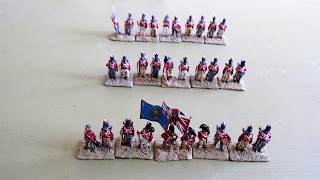
Napoleonic AB figures for sale – British and Portuguese


This is part of a large collection of Napoleonic AB figures which I bought and painted when I joined a club only using 18mm figures.   My preferred scale is 28mm, but I bought and painted these as a project.   They have hardly been used, and I would now like to find a new home for them. 

I have no idea what price to ask, but have been advised that double the price of a new casting would be reasonable.


This offer consists of

6        Generals

12      Riflemen

3        Portuguese Cacadores

8        Hussars

8        Dragoons

16      Gunners and 4 guns

30      Highland Infantry

30      Portuguese Infantry

30      British Infantry Marching

30      British Infantry Standing


Asking price is 530 euro plus post and package

Prefer payment by Paypal


Postage      

standard      no insurance

UK                25 euro         7-10 days              

EU                25 euro         7-10 days

USA             30 euro         14 days

Australia       30 euro         14 days       


Courier        tracked and insured 500 euro

UK                65 euro         4-5 days                

EU                40 euro         3-5 days

USA             130 euro       2-3 days

Australia       180 euro       3-4  days


Sunday, 23 January 2022

Gera Campaign


map of Europe

The next phase of the 1813 campaign is set in central Germany. 

It will be the 81st phase since the campaign started in April 2009, and the 8th phase in the sixth revision which started in June 2020.   This map shows the location of those six phases, the colour of the star indicates which side won that phase.   Gera is shown with a white star.

This is the second phase in central Germany.  The French won the first phase by taking Erfurt and forcing the Russians to retreat to Gera.   This phase will cover the French invasion of Gera, and the Russian attempt to hold and defeat them.

campaign map

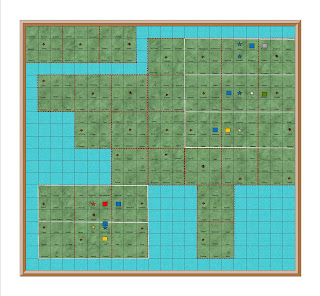
This map shows the campaign area

It covers the area between Erfurt and Gera

The district border is in the middle of the map


Each square is a 2x2 foot scenic square.  

Nine squares is a wargames table.  

Nine squares is also a military district.   


This map is used for tactical (daily) movement


The French objective is to take and hold the city of Gera

The Russian objective is to defeat the French and hold Gera

Comments

This campaign will continue the revised orbat of six corps per side which was introduced for the previous Cuidad Real phase.  

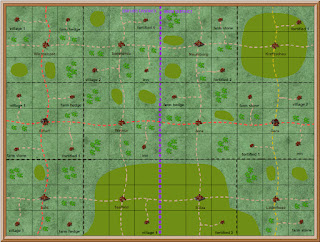
The campaign area is relatively open, and there are no rivers.   There are only two mountain areas, which should allow for more open battles/wargames.

Sunday, 16 January 2022

Cuidad Real Campaign - Day 10


30 April 1813 – Southern Spain – Day 10

Despite the Spanish victory at Cuidad Real, it was obvious to general Giron that he was now in an impossible situation.   The loss of 3rd Army meant that he was outnumbered two to one by the French.   Any delay would allow the French to concentrate four corps against two at Cuidad Real.   Consequently he ordered 1st and 2nd Spanish armies to retreat and abandon both Cuidad Real and Malagon.

Marshal Suchet wanted to destroy the Spanish army before they could retreat and escape.   Despite a shortage of supplies he ordered all three French armies to engage the Spanish.   14th and 15th armies would attack Cuidad Real.   13th French army would attack Malagon. 

The retreat of the Spanish army prevented any further engagements.   The French occupied both towns with out any resistance.  

Suchet had failed to destroy the Spanish army, but he did occupy all of the Spanish towns, including Cuidad Real.   He therefore won the campaign.

Comments

The battle of Cuidad Real should have been the deciding one of the campaign. This city was the campaign objective of both sides.  

After nine days, and nine battles, both sides were at the end of their operational capacity.    Both had received considerable battle casualties.   Both were very short of supplies.

In normal circumstances the French should have lost the campaign when they lost the battle of Cuidad Real.   Although they had won five of the nine battles fought, their over extended lines of supply would have forced them to retreat to consolidate their depots.

Because of effective guerrilla activity the French had to detach more than half of their cavalry to protect their lines of supply.   This left the field armies at a distinct disadvantage.   The Spanish already outnumbered them in infantry, now they also outnumbered them in cavalry.  Without effective cavalry the French were unable to overcome their lack of infantry.   This resulted in more defeats than would be normal in Spain.

For the final battles the French had recalled about half of the detached cavalry.   It was a risk, because it would have an immediate effect on their supply system.   If they could quickly defeat the Spanish armies they would be able to live off the captured Spanish supplies.   But they would have to defeat three Spanish armies one after the other.

The Spanish won the first of the battles at Malagon.   The French won the second battle at Almagro.   The Spanish won the third battle at Cuidad Rodrigo.   So why didn’t the Spanish win the campaign?

The reason is the location of the Spanish armies for this final phase of the campaign.   They had already been forced to retreat from the central battles of Consuegra, Damiel and Valdepenas.   They were at the extreme left of the map for the final three battles.   The campaign rules are that if a corps retreats off the map they have left the campaign, and cannot enter again.   The Spanish defeat at Almagro meant that 1st Spanish army had to retreat off the map, and thus leave the campaign.

Despite their defeat at Cuidad Real, the French now had six corps against the remaining four Spanish corps.   Suchet could now bring four corps against the two at Cuidad Real.   Having forced 1st Spanish army to retreat off the map he could then bring all six French corps against the remaining two at Malagon.

Not surprising that Giron ordered 1st and 2nd Spanish armies to retreat before the French could destroy them both in two battles.

This is why I so prefer campaigns rather than one off battles.    The outcome of the campaign is not decided by the side who kills the most enemy.   Nor is it only decided by who wins the most  battles.   There are strategic objectives which are just as important as winning battles.   One is supply and another the location of the battles.

It is possible, though unlikely, that one side could win more battles than the other and still lose.  For example the French could lose the advantage in the centre (14th French army) and south (15th French army) but still win if 13th French army forced 2nd Spanish army to retreat off the map in the north.

In this campaign the French won more battles, but they were held in check in the centre and north.  It was only the retreat of 3rd Spanish army in the south which gave them the campaign.

I think that the French deserved to win (but then I did command them).    They were outnumbered throughout the campaign, and they had increasing supply problems as they drove the Spanish back.   They also lost critical battles, though never suffered a crushing defeat.   If the Spanish had forced a draw at Almagro they, and not the French, would have won the campaign.

A very, very enjoyable campaign to play, and a good illustration of why Spain is fast becoming my favourite of the five campaign areas in the 1813 campaign.

Sunday, 9 January 2022

Cuidad Real Campaign - Day 9


29 April 1813 – Southern Spain – Day 9

15th French army have occupied Almagro and forced 2nd Spanish army to retreat and quit the campaign.


The French have effectively won the campaign.

The loss of 3rd Spanish army means that the Spanish can not hope to win

However the fate of Cuidad Real is still be be decided.

The French campaign objective is to take the city, and to destroy the Spanish Army.   After eight days, and eight battles, the Spanish have been driven back to the final three towns of Malagon, Cuidad Real and Almagro.

The Spanish have held Malagon, and lost Almagro.   All now depends on Cuidad Real, which is the main Spanish depot for this campaign.

The French have won five of the eight battles fought, but are now at the end of a long supply line.   All six French corps are low on supplies, and carry considerable battle casualties.   They are relying on taking Cuidad Real to provide much needed supplies.  

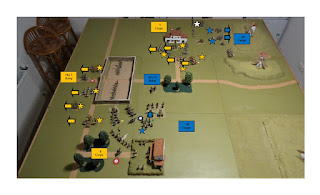
Battle of Cuidad Real end of move 12

The French started the battle at a serious disadvantage.   The Spanish held a strong defensive position, and outnumbered them 14 brigades to 11 French brigades.

The French deployed in the true and tested two corps and a strong reserve in the centre.  The reserve consisted of both artillery batteries and two elite infantry brigades.

The reserve was ordered to support the Italian corps, which was on the French left flank.   Unfortunately they suffered a serious of setbacks.   Spanish cavalry routed both artillery batteries, and one of the two infantry brigades.

Without the support of the reserve, the Italian corps was unable to make any impression on the Spanish right flank.  Their opening attack was on a woods held by a single Spanish infantry brigade.  The outcome was the loss of their cavalry and one infantry brigade.  The sole remaining Italian brigade was hard put to hold half of the woods.

The French corps on their right flank could do no wrong.  Despite the loss of their artillery and best infantry brigade to the reserve, they eventually broke the Spanish left flank and took the north east section of the town.

At nightfall the Spanish still held the south east section of the town, and the remaining French infantry were in the wrong position to launch a final attack.

The French had failed to take Cuidad Real, they had also failed to crush 1st Spanish Army.

Comments

On the surface this critical battle looks very much like many of the earlier battles.   Once more the French were outnumbered.    Once more the Spanish held a strong defensive position.    The sole French advantage was that they held the initiative and could dictate the critical point of attack.

Once more the French weakened the two flanking corps to create a strong central reserve.   Once more it consisted of both artillery batteries and two elite infantry brigades.  This would leave the two corps without any artillery and weak in infantry.   Neither would be able to attack the stronger Spanish corps to their front, who not only had more infantry but also had artillery.

French success would depend on good use of their reserve.   In this battle that reserve would support the Italian corps, which was the French left.   However it would not be sufficient to defeat the Spanish corps to their front.  They would also have to take the strongly held Cuidad Real in the centre.

To so so the French artillery would have to advance to close range of the town.   Despite their infantry support, the guns would be very vulnerable in the final approach to the town.

Move 6, exactly half way through the game, would be the deciding move.   The French artillery would have to advance within charge move of the Spanish cavalry in order to unlimber within short range of the town.   Which side moved first would be critical.  This is decided by drawing a (poker) chip showing the corps to move first.   The Spanish moved first.

The Spanish lancers charged the nearest French battery.   The gunners had just unlimbered, but their infantry support was just out of supporting range.   Normally the infantry should be in square and offer a safe refuge to the gunners.   The Spanish charged and the French gunners tested to see if they could evade.   The gunners lost and must now stop the enemy cavalry with firepower.   They only needed 5 for a hit with 2D6, they totalled 4.   The Spanish charged home, the gunners were broken and routed with 10% casualties.   A rout is 8” directly away from the cause of the rout.   This sent the gunners right into their infantry support.   The infantry had to test their morale, they needed 3 with 1D6, they rolled 1 and joined the rout. 

Half way through the game the French reserve had lost half of their artillery and infantry.

The French were more sucessful on their weak right flank.   Here they defeated the Spanish corps to their front and even took part of the town.   But it was just not enough.

To win the French needed to defeat the First Spanish Army and take the town.   They failed to do either.  

It may have looked just like the earlier games at  the start, but this one proved to be one of the most difficult games for the French commander (me).   They had good luck to balance the bad.  But unfortunately it was in the wrong place and at the wrong time.  

All of which made for a very enjoyable game, and a well deserved win for Jan.

Sunday, 2 January 2022

Cuidad Real Campaign - Day 8


28 April 1813 – Southern Spain – Day 8


All three French armies are running short of supplies

All available supplies are moved forward from the rear depots

Fortunately the guerrilla bands are regrouping and resupplying after a busy period

The recall of French cavalry brigades to the forward armies also helps to safeguard the supply convoys


15th French army ordered to attack Almagro,

29 French cavalry brigade ordered to return to take part in the attack


Battle of Malagon end of move 8

General Halbert is well aware that he must not only defeat the Spanish, but also take the town if 15th French Army is to survive. He has one more day’s supplies, and he must take the town to feed his army. If he is defeated he will have to retreat without any supplies, and will lose attrition casualties until he gets more. In this condition his army will be easy prey to the numerous guerrilla bands.

Once more he robs both corps to create a strong reserve of both artillery batteries and the two best infantry brigades. The reduced corps will attempt to pin the enemy whilst the reserve moves to close artillery range of the town.

His right wing is the weakest, and they cannot advance until 29 cavalry brigade re-joins them from patrolling the lines of supply. They are not expected until mid afternoon, and may be too late to take part in the battle.

The Westphalian corps on his left moves to attack the Spanish corps opposite. The reserve deploys close to the town, but offers covering fire to the Westphalian infantry. Together they break the Spanish right wing, and the artillery then concentrate on the town. The conscript garrison break after a short defence, and the reserve infantry move into the town.

At nightfall the Spanish flanks are still fighting. But with their centre gone, and the town taken, they retreat under cover of darkness.

Comments

To win the French must concentrate, and this means weakening both corps.

To take the town, which is the game objective, they must concentrate the reserve against the garrison. By the time the guns are in position it is usually at least move eight. They have four moves to weaken, and then storm, the garrison. In effect they have two attempts to use their artillery at close range. This is not the time to throw a run a low dice.

In this game the French pulled it off, but only just.

The Spanish attacked their weak right flank, and won the flank

The reserve had to support the attack against the Spanish right flank before they could concentrate on the town. On move eight the Spanish still held, and the reserve had to be redeployed to attack the town. Fortunately the garrison broke quickly, otherwise it would have been a draw. In this battle a draw would be a Spanish win.

This was one of those games where the outcome is uncertain right until the last move.

Sunday, 19 December 2021

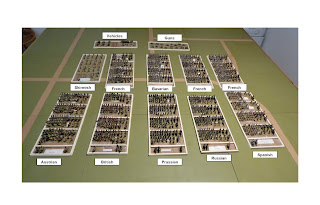
Sale of AB Napoleonic Army


It is about six weeks since I last mentioned trying to find a new home for my unused AB Napoleonic Army.   Despite the lack of comment on the blog, there has been a lot going on in the background.

I always expected that the sale would be complicated and time consuming, and I have not been proved wrong.  It is largely for this reason that I have put off the project for many years.

You may recall that the whole army consists of 1320 foot and 210 mounted figures.   There are also 16 guns, an ambulance set, a pontoon set, a caisson and a baggage vehicle.  .   The whole is organised for use with my 1813 campaign.   There nine army groups, plus an assortment of skirmish stands.  

The first step was to ask for advice about how best to approach the sale of these figures.  I asked for suggestions both on here and on TMP forum.   I received a lot of useful advice, but I was then left with three decisions.

First whether to try to sell the whole collection together, or to break it down into smaller groups.

Second how to price the figures

Third how to pack and post the figures

I decided that before I offered any figures for sale, I would have to answer all three questions.   But not necessarily in the sequence shown above.

I think the most important one is the second, how to price the figures.   After some consideration, and many suggestions, I think double the purchase price of a new unpainted figures is reasonable.   One correspondent who sells large numbers of figures suggested that they might be worth more, but that they should find a buyer quickly at that price.   At present a foot figure is £0.80, a mounted figure £1.55 and a gun £3.80.   I have not been able to find out how much the different vehicles currently cost.   The whole collection would come to about £3000 plus post and package.

Packing the whole collection would be a huge task, and I have no idea how to even start on it.   I would probably have to pack them in national groups, which would mean ten boxes.    Would it then be better to send ten separate boxes through the post, or pack them all in a much larger box.

 I doubt very much that I would ever find a single buyer for such a large and expensive collection.

So I decided that I would offer them in national armies.   These would be Austrian, British, Prussian, Russian, and Spanish for the Allies.   Plus French Guard, French line, French allied and Bavarian.  The skirmishers would be rebased and included with the main armies.   There are not sufficient guns for gun crews, so some sets would include guns, others not.

Each set would have about 150 foot and 16 cavalry.   This size would be reasonably easy to pack, and the average cost would be about £300.   Leaving aside whether I can find buyers for all ten sets, at least the prospect seems more achievable than a single buyer for the whole lot.

This would mean that I would have to rebase the skirmishers and include them with the national army. 

I will then have to take photographs of the new groups.   And in doing so I want to try to get better quality close ups of the figures.   My camera is a basic point and shoot model, and not really suitable for close up of so many figures.   I will have to see what I can do about that.

Then I will have to find out about postage.   I would like to get options for sending each package to UK, EU, America and Australia.   If possible I would like a basic post and a fully insured option.   The latter would be my preference, but at lot will depend on the cost of each option.   Before I can do any of this I will have to pack one box to determine the size and the weight.

Sunday, 12 December 2021

Cuidad Real Campaign - Day 7


27 April 1813 – Southern Spain – Day 7

13th French army attack 2nd Spanish army at Malagon for second day

French have one day’s supply, by nightfall they will have run out

10 guerrilla attack and destroy routing 13 French brigade

7 guerrilla retreat when 26 French cavalry retake La Roda


14th French army prepare to attack Cuidad Real

27 and 28 cavalry brigades ordered to return to corps


15th French army reorganise

12 guerrilla attack Pozo, routed with 20% casualties

Battle of Malagon end of move 8

Day two started with both armies redeployed, but carrying all battle casualties from day one.


The French were weak in cavalry, with only one brigade present and with 20% casualties.  

They were also outnumbered in infantry.

Their only advantage was artillery.   Both sides had two batteries, but the Spanish gunners were all C class.

The French concentrated their artillery, cavalry brigade and one elite infantry brigade under the command of the CinC


This left the two corps with only three infantry brigades each, and consequently outnumbered by either Spanish corps

The main attack was on the French left, supported by the reserve.

The artillery was less than effective, and played little part in the battle.


The Spanish fought much better than might be expected.

Their left moved forward and engaged the Polish corps, who were using the woods for cover

This battle went on for most of the day, and ended in a draw


Despite a determined attack, the French made little progress on their left

They forced the Spanish to withdraw, but failed to destroy them

They managed to take the southern half of the town, but the Spanish held the northern half


At nightfall both sides had suffered similar casualties.

But the Spanish still held half of the town

And the French had failed to either take the town or destroy the Spanish army


The battle was declared a Spanish victory


Comments

Outnumbered in infantry and cavalry, the French commander had few options.

He opted to create a very strong reserve of artillery supported by infantry and the weak cavalry

The Polish corps was ordered to hold the woods on the right, and pin the Spanish corps opposite

The French corps would attack on the left, supported by the reserve.


The success of the attack would largely depend on the French artillery.

They would need to weaken the Spanish infantry, who would then be attacked by the French infantry

Unfortunately they failed to do so.  In fact they only achieved two hits throughout the entire battle.


The Spanish once more fought much harder than expected.

The garrison of the southern half of the town were militia, and started the battle with 20% casualties

Yet they held the town until move eleven of twelve.


On the opposite flank they attacked the much weaker Polish corps

The Poles were using the woods as cover from the Spanish cavalry and artillery

So the Spanish infantry had to attack a strong defensive position

They used their superiority in infantry brigades to bring at least two Spanish against each Polish brigade

This worked well, and at the end of the battle two of the three Polish infantry brigades were in rout

However the third brigade continued to hold one of the four sections of the woods.


I was the French commander once more.   As always timing was critical in this game.

There are twelve moves before nightfall, and both armies were fully deployed and in close contact.

In just two moves the French artillery were within range of the Spanish infantry

Normally four moves would be sufficient to inflict casualties on the Spanish infantry

The French infantry would then have six moves to close to contact and crush the Spanish.


However the artillery failure to inflict any casualties at all made an infantry attack risky

So the artillery were allowed an extra two moves to fire on the Spanish

The result was only two hits, and both Spanish brigades passed their morale tests

The delay also meant that the French would be limited to one attack only before nightfall


The battle on this flank was decided by a single infantry combat

One French brigade in column moved into contact with one Spanish brigade in line

Normally the French should have won, but not this time

The Spanish brigade was the best of a bad bunch, with B class infantry

The French brigade was the worse of their corps, with C class infantry

The Spanish infantry won – the French brigade routed.


Strange that no matter how carefully you plan the attack, it often goes wrong at the critical time

In this case great care was taken to put the best French brigades at the head of the attack column.

However the elite brigade suffered two hits, reducing them to the weakest brigade

The next best brigade was in the wrong place at the critical time

The attack fell on the weakest brigade, who had been sent to outflank the Spanish


Despite losing the game, I found this a very interesting and enjoyable experience.

In the heat of the moment I had forgotten that I was using my weakest brigade, until it was too late

But it would not have made any difference, it was attack with them or not attack at all

And as it happened on move 12, time had simply run out.


There are two more battles to decide the outcome of this campaign.

But this defeat is not a good omen for the French.